 Play this video
Listen to this messageDownload MP3
Keeps playing while you browse the site.
Read the transcript
Good morning, Salt Church. So glad to see you this morning. So glad you connected with us today. I miss you terribly and I can't wait till we're back together. We're in our series going into week three now, Faith Over Fear.
But let me just share a few things with you. First of all, next week is Mother's Day and we're excited about sharing with our mothers. But we do have a special treat. My wife, Miranda, is going to be speaking next week. I'm going to be sharing from a mother's perspective about Faith Over Fear.
And I would love for all of you mothers to be present with your family and it would be an honor to have you. I think it's going to be a powerful message. She's a great communicator. Runs circles around me and she would love to and would be honored if she could speak into your life next week. So prepare for next week.
Also, guys, we are planning to be back together at some point. So I want to remind you of that our new location will be the Museum of Contemporary Arts, MOCA. Some of you have been asking, when is this going to happen? What's going on? What's the latest?
Well, as you know, we're still around June is when things are going to open back up. So we're kind of in limbo as to what that's going to look like. But we are starting to plan some phases of coming back together. So when June comes around, we're definitely still going to be doing this through May. But when June comes back around, we'll be giving you more information about what we're doing.
We don't know what the mandate is going to be at that point. It could possibly be less than 50 people and there could be some standards in place. So we've got to figure that out. But we're desperately hungry to get back together. I know all of you guys are ready to see each other again.
And I'm so just excited about getting back together with you as well. So be on the lookout for that. And we'll keep you up to date with that. I do want to let you know that we do have some new initiatives going on. And we're supporting some some local services here in the area through your giving.
We're going to take care of some home health nurses, their frontline workers. And I just want to let you know your giving makes that possible. If you want to be involved with that, just let us know. We're going to put some care packages together and do some things for them. Also, some of our frontline workers in the EMS community and things like that.
So we're we're thrilled to be able to be a church that is thinking beyond ourselves and thinking about our community and all those people in the frontline. Excited about that. So we are in week three of our message series. Now, remember, before we get started, I want you to start connecting. I want you to start posting in the comments section.
I want you to start some watch parties right now because it's really important that you do this. Remember why we exist to reach people with the life is giving message of Jesus. I know this is we want to feed you, obviously, but we also want to reach others. And by you doing this, by you connecting, by you interacting, we're able to connect with people at greater lengths. And that's why we do what we do so that people can come to know Christ.
And through the power of the gospel of Jesus Christ that I'm getting ready to share, I believe that God's going to do some some miraculous work. So just go ahead and hit that watch party button. Take it over to your community. Interact with some people. High five some people online.
Throw some emojis out. Give me some love. I need some love this morning. OK, so just just do that for me. So faith over fear week three.
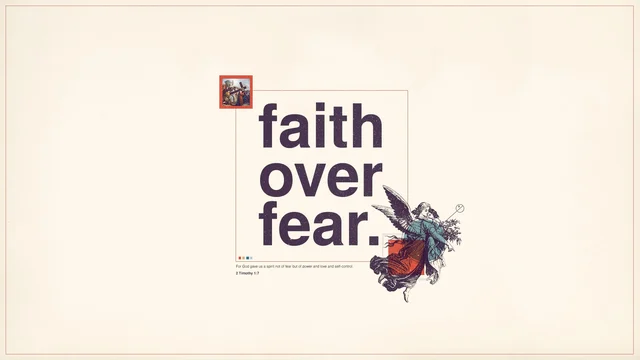
So let me just go over the key scripture. 1 Timothy 1 7 says, For God has not given us a spirit of fear, but of power and of love and a sound mind. He has not given us a spirit of fear, but of power, power being from the Holy Spirit. He has given us that ability to overcome our fear and by love that we have a God that loves us. Therefore, we can practice love and conquer fear and a sound mind.
Exactly what we're doing here today. We're learning the knowledge of of who he is and how to conquer fear and what scripture says so we can practice and we can beat fear through these things. So in week one, we talked about worry. Right. We talked about Jesus's teaching on why are you worried?
He says, look at the birds. Look at what's going on there. Look at the flowers in the fields. They're taken care of. Why are you concerned about tomorrow?
Won't your heavenly father do much more for you? He loves you more than the birds. He loves you more than the flowers in the field. So what are you worried about? So we talked about that in week one.
Last week, we talked about when anxiety attacks and and we can access peace through praise and prayer and praise and prayer is our access point. It's our pathway to peace. And we can gather that peace when we are facing anxiety. Don't be anxious about anything. And a peace that passes understanding will come over our heart.
You can go back and listen to those messages and catch up. There's a lot more information in those messages to to to to go back and kind of build upon. And we and each week we've been building a little more. And this week, I want to talk about something that's very hot topic right now. Everybody's talking about it.
And that's the economy. And none of us here. Here's the deal. None of us saw this coming. None of us knew that this was going to happen.
And none of us have actually experienced anything like this. Nobody in our lifetime. Yeah, sure. We've gone through recessions and there's been ups and downs and we've probably experienced some some down points, especially around 2007, 2008, when we had had a longer period of recession. But but nothing like this in our lifetime, not since the Great Depression, have we experienced anything like this.
In fact, anybody who's living today that probably was alive during the Great Depression was probably really young. And and it's an unprecedented thing to to look at the economy, to see the stock markets fall, to see a halt on the economy. I mean, I don't think our world has ever seen anything like that, this, at least in recent history. And it's just a thing that everybody's uncertain about. And so I think about that.
I think about what people must be. I mean, the fact that a virus can come in and and nobody saw it coming. I mean, you can you can go back and explain economic theories and why things happen. But nobody predicted something like this happening and causing what is happening now. So who could?
How could we how could we know? So there's a lot of uncertainty. And, you know, I think about my grandmother when I think about things like this. She was alive during the Great Depression, a very young girl at the time. And my grandfather was a successful businessman, a farmer on lots of land, had lots of of resources and what you would you probably wouldn't call him a rich man.
But he was certainly comfortable and they lived well and everything was going well. And then overnight, overnight, the stock markets crashed. Everything went. They had to sell their land. They lost everything in just a short period of time.
My grandmother shared this experience, how everything was lost overnight, how they had to redo life. Life was was never the same. Everything completely changed. And they learned how to reuse, to reallocate, to repurpose and and to live off of little. And she carried these traits through her entire life.
And we always picked on on granny. We called her granny. We always picked on her because she could reuse anything. She could repurpose anything. She would read.
She could do anythingincال she could reads. Use paper towels. If we used a paper towel and wiped off our hands and we were getting ready to throw it in the trash can, she said, no, no, no, no, I can reuse that. And she would wring it out and clean it out, hang it up and dry it. She would, every little box that came into the house, whether it was a cookie box or a gift box, she would use it.
She would take it and put it away. She'd clean it up. She'd redecorate it, whatever she could do. And she would put things in those boxes and she would use them. She just could not throw away anything.
She would repurpose or reuse or sanitize toothbrushes. So she would take toothbrushes and wash them out, sanitize them, and use them again for other things. If people needed toothbrushes, she would have those. She just had this mentality that nothing was wasted. And there was not an inkling of food.
That was wasted in her house. It was always used for something. There were always leftovers. And she would put out all these different, different leftovers. But what was really, uh, moving for me about my grandmother, I loved my grandmother to death.
And, and the one thing that was, that was real for her is that she appreciated everything. It didn't matter what she had, what you gave her at Christmas. She didn't want a lot. Things that weren't really important to her. She was just appreciative for her.
She was just appreciative for what she had. And, and she, because she had experienced what it was like to have nothing and to lose everything. And that generation was like that. They just knew that there was something more than just the things of this life. Uh, her faith and her trust in God was so real.
Her family knew what faith was. They had an eternal perspective rather than a things perspective, rather than, rather than a money perspective. And they lived life that way. And they lived life that way. Eternity was in, she'd always talk about eternity.
She always thought in terms of eternity. And everything that she did, it was what was most important to her. And, and, and, and her faith was most important to her. Her security lied in her faith. Her security lied in that way.
There are, uh, when I go back to, to scripture, um, and we're going back to week one, cause I want to dig into that a little more. In Matthew 6, 24, Jesus had a conversation about money. We talked about right before we went to the birds and worry and things like that. And we kind of talked about, and we kind of talked about, look at the bird. We saw that Jesus started out with the subject of money.
He talked about, you can't serve both God and money. You have to choose one, right? It wasn't that Jesus was concerned about money. He, he saw that you were concerned about money. And, uh, he talked about money because here's what, and I love how Craig Groeschel puts this, money promises only what God can provide.
Money promises only what God can provide. Cause there's two things, and I talked about this a few weeks ago, but I want to dig into this a little deeper. There's two things that we believe money provides. Happiness and security. Happiness.
If I buy more, if I do more, I'll be happier. If I buy more, if I have a better car, if I have a bigger house, if I, and the psychology of that is if I have this, I will be happy. Man, Amazon is blowing up right now. Man, they're making so much money during this time because people are trying to find happiness and stuff. They're buying like they never have before.
They, they're buying things that they never thought they would buy before because of that. People are buying. And, and even before this crisis, we leveraged ourselves in our spending. We, we, we went in debt because we believe that that's what brings us peace. And that's what brings us, brings us happiness.
And the second thing is security. We, we want security and we build our retirement. We build our bank accounts. We build cushion so that we can have security. So you're on one side of the fence with happiness and the other side of the fence with security.
But really what it comes down to is if you lose a loved one or someone is diagnosed with a terminal illness, not all, you can have all the money in the world and it will not bring security. So where does our security and our happiness lie? During the great depression in 1932, it was a few years after the depression started, uh, the suicide rate went way up. And the reason that, uh, people's people, uh, uh, went committed suicide during that time is because they found their self worth in happiness and security. And when the happiness wasn't there and the stuff wasn't there and the security of having a job and the security of having a healthy, uh, financial situation wasn't there, their self worth was lost.
See, wealth is the number one competitor of our heart. And Jesus knew that wealth was the number one competitor. Money was the number one competitor of our heart. But you can't serve two masters. And that's why Jesus spoke on that.
In Luke 12, Jesus shares a parable that I think really speaks to this. Luke 12, beginning with verse 16, he says, the ground of a certain rich man yielded an abundant harvest. And he thought to himself, what shall I do? I have no place to store my crops. Then he said, I know what I'll do.
I will tear down my barns and build bigger ones. And there will be, and there I will store my surplus grain. And then it is, so he's basically saying, you know what? I have a lot of money. I have a lot of wealth.
What am I going to do with it? Hmm. I think I'll just build bigger bank accounts, build bigger bank account. And then I'll say to myself, you have plenty of grain laid up for many years. Take life easy, drink or eat, drink and be merry.
But God said to him, you fool. This is Jesus. This isn't me. This is what he said. Jesus was sharing this story.
He says, God said you fool. And this is probably one of the few times in scripture where we actually see God call someone directly a fool. This very night, your life will be demanded of you. Meaning, you're not going to live. You're not going to live much longer.
This is how it will be with whosoever stores up things for themselves, but is not rich towards God. So what he's saying here is we don't put our trust in wealth. We don't put our trust in the stock market. We don't put our trust in the economy. We put our trust, we're rich in God.
Not rich in wealth, but rich in God. We need to be rich towards God. But there's something inside of us, all of us, that wants to build our kingdom, right? We want to build our dynasty. We want to be owners of our empire.
We're building ourselves. In fact, that's the American way, right? I mean, you know, I pick myself up by my bootstraps. I make something of myself. It's about me.
It's about what I can make and what I can do and the power that I can have to do anything with my life. But Jesus talks about something completely different. He doesn't talk about being a king. He doesn't talk about you being a master. He talks about you being a servant.
Look in Mark 10, 43 and 44. Not so with you. Instead, whoever wants to become great among you must be your servant. And whoever wants to be first must be slave of all. And then he goes on to verse 45 and says, For even the Son of Man did not come to serve, to be served, pardon, but to serve and to give his life as a ransom for many.
So he says, I didn't even come in power. I didn't even come to rock the economy and take over and bring some kind of... economic power in the play and some kind of global rulership in play. I came to serve and I came to give my life. So he flipped the script here with the people of that day because they believed that he was going to be the king and master and he was going to bring wealth and they thought about King Solomon and King David and all those that went before them and he thought about, they were thinking about Christ being this type of person, yet he gives them this audacious statement about being a servant.
In 260 A.D., Dionysus, the Bishop of Alexandria, wrote some letters that we still have today that we can read back and look in church history. They're still available to us and he talks about a plague that took place in Rome and the pagans were fleeing Rome in that day and they were taking their kids and their families in fear that they were dying. And there were so many deaths during that period of time.
But the Christians, the Christians were the ones who stayed and cared for the dying and took care of those who were far from God. And he wrote this statement. They exchanged their wealth and well-being so that they might care for those who were dying so that they may both be serenely happy. Serenely happy. And during this time, Christianity exploded.
It grew because people could not believe that someone else could love like this, that someone else could serve like this. It was people that were giving their lives, that were taking on this horrendous disease. It reminds me of the early church in the book of Acts where when the church was starting, they were together and they ate and fellowshiped and they broke bread and they brought money in and nobody was in need. And there were actually people who were selling their property and selling their wealth because they had experienced something in the risen Christ they'd never experienced before and they wanted to love others and they gave freely of themselves. Jesus gives us an answer to this fear by looking at him and the church.
And here's what he says in Matthew 6, 19 through 20. He says, Do not store up for yourself treasures on earth where moths and vermin destroy and where thieves do not break in and steal. But store up for yourself treasures in heaven where moths and vermin do not destroy and where thieves do not break in and steal. So it's not. See, what he's saying is these things that you're storing are not going to last.
You can't take it with you. And he's telling us to invest into something else. We're investing into things that don't last. Why not invest into things that last? What he's telling, he's giving us a clear picture of what's happening beyond where we are now.
Now, does this mean that we aren't to be responsible? Absolutely not. We are to be responsible. We are to take care of our families. We are to take care of ourselves.
We are to not go into extreme debt and do things that aren't healthy financially. But he says the most important thing to do and why you do those things is so that you can make the proper investments in what really matters because the things in this world, time is fleeting, it's fading, it's going quickly. We're here today and gone tomorrow as Scripture tells us. But there's something eternal. There's something beyond this world.
And it's a heavenly place. And we invest in this eternal look at what's happening beyond us. 1 Timothy 6, 17, 19, Paul's writing to the church and telling Timothy to command the people who are rich in this present world, do not be arrogant, nor to put their hope in wealth, which is so uncertain, but to put their hope in God who richly provides us with everything for our enjoyment. So he uses that phrase, this present world, command those who are rich. Now, who are those that are rich?
Man, we are rich. Yeah, it might not feel like that right now. I know some of you are losing jobs and you're losing retirement and things like that. But we're far better off than most of the world still. And we have roofs over our head and most of us have food available to us.
And so many other parts of the world don't have this. I've visited third world countries and I know and I've seen what people are living on and how just impoverished they are. Yet we are blessed. And he's telling these people, you may not feel rich, but in this present world you are rich. So don't be arrogant and build your hope on wealth.
He says that don't build your hope on wealth. See, that's where the fear is coming in. And when we build our hope on wealth and wealth doesn't last, then we lose what we have. And it's so uncertain. It's so uncertain.
It came in and a lot of our stuff is gone now. I know I lost thousands of dollars in retirement just in a few days in my own financial situation. But I'm not fearful because I don't put my hope in those things. And he's telling us not to put our hope in those things, but command those. I love how he says this.
But command them to do good and to be rich in good deeds and to be generous and willing to share. And in this way they will lay up treasure for themselves as a firm foundation for what? The coming age. So he's giving them a picture of something beyond where we are right now. You've got eternity you're looking towards.
So that they may take hold, and he ends it like this, with the life that is truly life. Because the life that you're witnessing now is not life. Yeah, it's a temporary moment in existence. But the life that he's talking about is eternal and everlasting. Everlasting.
He talks about this everlasting life. Jesus came to give everlasting life. So what we're doing now matters in eternity and in time. What we do with what we have, what we invest in, is for a greater purpose throughout eternity and time beyond what we're experiencing currently. And the early Christians understood this.
It wasn't their current condition that made them decide what they were doing because, for them, it was the possibility of being put to death. They didn't live under a democracy and under liberties like we do where you celebrate the freedom of religion. They didn't have that. So they lived with hope and joy of eternity. That's what they marched towards.
That's what kept them going. That's why they were able to even rejoice in the midst of persecution. Because they held on to something greater than my stuff and my happiness and my security in this world. But God promises happiness and security beyond this present world. They held on to that.
Because their lives and our lives should be preparation for the life. You know, I haven't realized this as many solutions. Here we go. Thank you. To come.
So in application, what does that look like? Because this life is preparation for the next, here's what I'm going to value. Here's what I'm going to put my faith in. Not in the fear of the things that are going to fade in this life. I'm going to give you just three things here.
First of all, stewardship over ownership. Stewardship over ownership. Now this is really practical and I want to help you kind of take hold of this. If we want to eliminate fear, we've got to practice servanthood. We've got to practice generosity.
We've got to do more because generosity is the avenue in which we can grab on to peace and hope. And it takes away our fears because we're investing in eternity. We're changing our mindset. Stewardship over ownership. One of the greatest financial minds that I've ever known.
I sat down with him many years ago when I was getting ready to go to college. And a very successful real estate man. Owned properties all over Myrtle Beach and down the coast and in and out of different areas. Just a wealthy Christian businessman. And he gave me the greatest advice.
He said the first principle to money is that God owns it all. It's God's. Everything you have is God's. And he taught me the principle of giving strategically. We need to be intentional about giving strategically.
He said first of all, you give a percentage to God. Then secondly, you give a percentage to investing. And then the third, you live off of that. He said if you can get that right. First of all, it's God's.
And then secondly, you're investing and giving to retirement, putting in the places that you're supposed to and then live off the rest. You will not fail. And he lived by that strategy his entire life. And it really helped him. He was blessed because of it.
So what do I mean by giving strategically? Strategic giving? I mean percentage givers. Percentage givers. Now, not everyone gives equally.
Okay? So if you make less money than I do or I make less money than you do, then we're probably not going to be able to give as much. But we can give and sacrifice equally. It's not giving monetarily equally, but it's sacrificing equally. So I think it's important to be strategic.
And wherever you are right now, like if you've lost your job or you've had to cut back, you need to sit down. Or if you need to get with your spouse, you need to sit down and decide in your heart because that's really what it's about. Deciding in your heart percentage-wise and budgeting what you're capable of giving. In the Old Testament, there was a law of 10%. It's a principle in the New Testament.
That's where we get the term tithing, 10%. And the principle is a great training ground. I like to call it the training wheels of giving in which that's where you start or where you're getting to. And it's a good basis to start from. And you start with that 10% and then you build from there.
And then you decide in your heart. Okay? It's all about... Now, if it's not in your heart to give, then don't give and just hold on to your money, right? But the Scripture tells us everyone should decide in their heart what to give.
Because if God owns it all, then I'm just the manager and I'm going to give Him what's due His. And so we practice...Ren and I practice strategic giving. In fact, we give much more than 10%. We budget and we make a budget.
And budget percentage giving really works for us. We don't have to question. We don't have to think about it. And one of the things we said from the very beginning, no matter how little money we have, we'll always give that first 10% to God, 10% to the church, and then we'll go beyond that with whatever we can do or are capable to do in that period of time. We've made that decision.
So percentage giving is important. You know, our church practices that. We budget every year to give a certain percentage. So everything you give to the church, anything that comes into our house, is budgeted to give back out. And every year we stretch to try to give more.
I meet with my board every year and we put together a budget. And every year I'm trying to figure out how to leverage the money we have to be able to feed you, to do ministry, and do all the things that we are capable of doing, but shrink that down as much as possible and keep our church healthy so that we can give more away. And by the grace of God, we've been able to do more this year than we did last year. And we keep raising that percentage every year. And we're going to try to raise that percentage every year.
Look at it a little more, a little more, a little more. Stretch ourselves. And I'm asking you to set a budget up. And I'm not telling you it's going to be 10%. I don't know what it is for you.
But I want you to think and pray about a percentage. And because this is the way you're going to fight fear. If you don't do this, as believers, if you don't do this, then you're going to fight fear of your economic situation. And this is a great way to battle that, stewardship over ownership. What we do with our money is, and just to let you know, we give to international missions.
We invest in church planning and revitalization and pastoral care. We have local ministries that we've supported, and we've helped the children's organizations here in the area. And we want to do so much more to help people. And I believe, and it's worked for us, that percentage giving is the way to go. And we strategically and intentionally, strategically give.
The second thing is people over possessions. I'm going to value people over possessions. Because possessions burn up, but people live forever. People go to heaven, possessions don't. And we'll be intentional about giving our time and our treasure to reach people.
Our church has been doing everything they can to help people. It really is about people. It's about people. It's not about what we have. It's about what we can do to reach people with the gospel.
And just recently, this past month, since the coronavirus has happened, we've been exploring different ways to help people. One of those ways is we've been purchasing groceries for some of the elderly or those who are disabled that aren't able to get outside the walls of their home, or maybe their single mother that's just hurting right now, or may not even be hurting, but just can't get away right now. So we've been providing groceries for those people. We also gave some money to a local business that has been providing free lunches for kids in our community that may not have a lunch on a school day and their parents aren't able to provide. We're currently, as I mentioned at the beginning, currently trying to figure out ways to support nurses, home health nurses, that aren't really looked after.
And they kind of go into homes, and a lot of those homes may not be sanitized. So they're kind of putting themselves on the front line, and first responders the same, and how can we leverage and help people like that. So they're always looking for opportunities. And right now, some of you are like, well, what can I do? Well, the question should be, what can I do?
Look around you. Look around you. I love you. I love the idea of serving small. Right now, during this time, we can serve small.
Send a text or a letter to somebody, buy somebody groceries next door and drop it off at their doorstep. Just the other day, I mowed my neighbor's grass. Our guards are kind of connected, so I just decided to hit the grass out there. Just serve somebody. You know, check in with somebody in the church.
Let them know that you're thinking of them and ask them how they're doing and pray for them. Form, you know, connection groups on Zoom or other methods just to connect with people. This is really, really, really important. Serve small. There's lots of ways we can serve small.
I love how Chris Hodges says this, if you don't love people and use money, you will love money and use people. So what we do, we leverage our money, we leverage our time, our talents, and all of that to serve others. And when we come back together, there's going to be many opportunities for us to continue to serve, whether it's in the church or whether it's on a team or whether it's outreach oriented where we're back together and you can do things as a team. We want to be people who value the people over the possessions. And then finally, we want to value the eternal over the temporary.
See, this is what my grandmother had in mind. She valued eternity over the temporal. That generation valued. They sang songs about when we all get to heaven, that what a day of rejoicing that will be. They had an excitement about what was to come and what is coming and what is happening around them.
They didn't look at the things that were negative. They looked at the heavenlies and they knew that there was a hope beyond this, that their hope wasn't in the things of this world. They invested in eternity. When I watched my grandmother and the things she did, she didn't have much. She didn't really care to have much.
But one thing she did have, she gave my father and my father gave me. And that's hope for eternity. A love for a savior and a kingdom that is beyond this current age. A life that is truly life. That's what she brought to me.
See, the greatest deterrent to generosity and doing for others and serving others is the illusion that earth is our home. So many of us see this as our home. And the greatest weapon to fight fear is to practice generosity and to serve others. And it only comes by a clear understanding of the life that is truly life. The life beyond where we are now.
Eternal life. Not the temporal, not the things that fade away, but a life that goes beyond. And as I get older, I see my parents grow older. I see the world changing rapidly. But I don't fear, guys.
I just don't fear. I know this because I know this is just the beginning. The Bible talks about earth pain, growing pains. That the earth is in creation grown for redemption, for recreation. It's a beautiful thing when we think about heaven and what God's doing currently that we're getting glimpses of heaven.
I don't worry about economic troubles. I don't worry about things like that because my focus, I have a sound mind when I think about God and His eternal purposes. Our faith is only as good as the object in which we place that faith. If we place our faith in temporal things, if we place our faith in the stock market, if we place our faith on our 401Ks and 403Bs, then your faith is going to be skin deep. It's not going to go anywhere.
It's going to fade away. And you're going to be hopeless. But if you place your faith in Jesus Christ, Jesus Christ, the Son of God, the only thing that is eternal, then it will last. It will overcome the fears of economic troubles, of trials, of financial hardships. We trust in Jesus.
So, are you someone who needs to put their trust in Jesus today? He is the hope of the world, guys. He's the hope of the world. It's not some leader of the free world. It's not some economist with the answers to how to fix this thing.
That's not where our hope lies because that's only temporal. But our hope lies in eternity. So, we place our trust in Jesus. Maybe you're here listening to this message today. Maybe you've not been to church or familiar with church or maybe you went to church a few times or maybe you saw it as just something you go and do your Hail Marys and light some candles and things like that and those are all good and everything.
But maybe that's your limited understanding of God. But today I want to introduce you to Jesus Christ who is the hope of the world. He's really what it's all about. So, maybe you're asking how do I know Jesus? First, you have to admit that you are a sinner.
The Bible says we all have sinned and fallen short of the glory of God. You know inside of yourself, if you don't know Jesus, that there is something that's missing and you've done some bad things. But the cool thing about Jesus is it doesn't matter what you've done. He doesn't really care about that. He just wants you.
So, you admit that. You say, I'm a sinner. I'm far away from you, God. And then believe that He is the Son of God and that He died on the cross so that we could be forgiven of our sin. That's the point of His blood.
We can be forgiven. That He is the Son of God and He died on the cross and He rose again proving that He was the Son of God. He conquered death. He conquered sin and He conquered the grave and you no longer have to be afraid of death. You no longer have to be afraid of being just a temporal object in this world because you are eternal.
And then you confess your sin to Him. You tell Him, Lord, I confess my sin and I commit my life to You. You can do that today. You can make that decision. You don't have to be afraid of economic troubles.
You don't have to live that way anymore. You can live for God. You can live for Jesus. So pray this with me if that's you. Father, in the name of Jesus, I believe that You are the Son of God and that You died on the cross when I sinned.
I'm a sinner. I've been far from You. I've done a lot of things. But I know by Your blood I am saved. That because You were God, because You died on the cross, You were the sacrifice that was made for me.
So I confess my sin, I believe in my heart, and I commit my life to You today. Thank You, Jesus, for saving me. In Your name. Amen. Amen.
I want to celebrate with If you gave your life to Jesus today, it says the angels in heaven are celebrating and the church is celebrating with you. We're excited for you. Here's what I want you to do. There are some next steps if that happened for you today. First of all, you need to be baptized.
You can connect with us through the Salt Church page if you want to get baptized. In fact, you can write it down in the comments section if you want to do that. Let us know you want to be baptized and when we're back together, we're going to organize baptisms. We're going to have that happen. That's the first outward expression of what's inwardly happened to you.
That's the first step that we take. And there's no magic in it. It's just celebrating God and doing that as a church together. Secondly, you need to get plugged in somewhere. You need to get plugged into a local church.
Whether it's us or another church, we'd love to have you be a part of our family. Come in, be a part, get connected. We want to fellowship with you. Get connected to a small group. And start growing in Jesus Christ.
And any other thing we can do for you. If you need some information about next steps, we'll be glad to get that to you. So just connect with us online any way you can. We have our info page right on saltchurch.org.
You can connect there and send us some information there. You can also private message us here on Facebook if you want to do that or wherever you're looking at this service from. Just connect with us online. So we love you. So thankful that you, again, were with us today.
I hope you have a blessed week. And we'll see you next week for part four as my wife Miranda shares a special Mother's Day message. God bless you and have a good day.