

 Play this video
Listen to this messageDownload MP3
Keeps playing while you browse the site.
Read the transcript
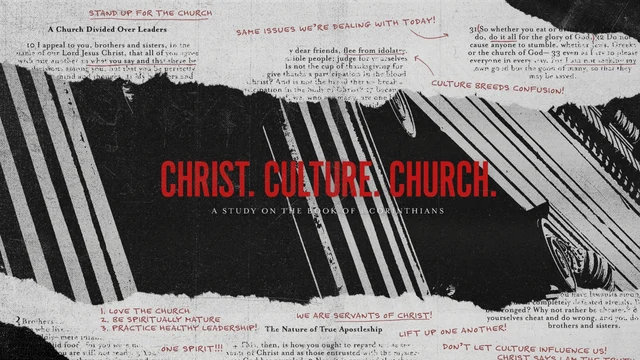
Well, let's start our message series in 1 Corinthians, and this series is going to carry us for a long time. I just felt it got a place on my heart. Let's teach through some books of the Bible. We usually do things in topics somewhat. We teach through certain books of the Bible.
We've been doing a lot more of that lately, and it's been great. And your feedback has been great, too, because some of you have really enjoyed that. And when I started studying 1 Corinthians, I started seeing a lot of things that are very practical for today. A lot of topics that we need to be talking about in 1 Corinthians. So this is a great opportunity for you to open your Bibles, dig deep, think about these things that the Apostle Paul left with the church and left with us.
And this is Paul's first letter to the Corinthians. And what I like to say is it's a calm, clear voice speaking in the midst of chaos. That's what the gospel is. Paul is telling us the gospel is a clear, calm voice that speaks to us and cuts through the noise of the world. There's a lot of noise around us.
There's a lot of things going on. But the gospel is that peace that sets us in the right path. So Paul planted this young church in his first missionary journey. In Acts 18, you can read about that. And Corinth is one of the most upcoming cities of the time.
It was a port city. It was an economic powerhouse, vacation destination. It was kind of the New York City of its time. All the young professionals wanted to live there. Cosmopolitan, rich, young, diverse people.
The city boasted with temples of Greek and Roman gods. And the architect was just unbelievable. It was a beautiful place. Everybody wanted to live in Corinth. And Paul had lived there for about one and a half years.
It was some of his best work. He reached a lot of these young people. A lot of them got saved. And he felt really close to these people. They were precious.
But after he left, he started receiving letters from his leaders that there's a lot of things going on in the church. Church isn't doing well. Things aren't doing well in the church. And there are five primary areas that we'll talk about over the series. And those five primary areas are this.
Number one, there were lots of divisions. We'll talk about that today. The division in the church. People were setting up little segments of their congregation and they were saying, I'm here and I'm there and I'm this and I'm that. And it was kind of this tribal mentality.
Second, they had sex and romance confusion, to put it mildly. They expected, you know, you can kind of expect this in a young city because there was a lot of young people. But it was happening in the church. The church was approving of it. Or the people in the church were like, you know, everybody else is doing it.
After all, we're two consenting adults. It's okay. So he sets a biblical principle to deal with the problem of sex, marriage, singleness, and divorce. And we'll deal with some of that. And then number three, there was a lot of acrimony about the different convictions of Christians and where and what they were allowed to do and what they weren't allowed to do.
Some of them were like, we need to be ye separated from the world and not touch anything unholy. And others were like, we're free in Christ and we can do whatever. And they needed to settle some of those differences. And we deal with those as well. Politics, the way we educate our children, the issue of drinking alcohol, yoga, Halloween, all those things that are debatable.
And we talk about how do we deal with those things as Christians in our culture. And he'll deal with that in chapters 9 and 10. And then fourth, their church services were chaotic, okay, to say the least. I mean, everybody had the Holy Spirit putting something on them. And they were interrupting the service.
And then if the leader or the pastor didn't agree with them, they said they weren't following the Spirit or they weren't listening to the Spirit or they were being used by Satan. And then people were having tongue wars. You know, they were speaking in tongues. This was speaking in tongues. I speak in tongues better than you.
It was crazy and chaotic. And Paul had to deal with that. And we'll deal with that in chapters 11 and 14 as Paul lays out the guidelines for the Holy Spirit to work in the church. And then fifth, there were some people saying the resurrection and the miracles of Jesus weren't all that important. That it's not really that big of a deal whether we believe them or not.
So Paul is going to explain why the resurrection is everything. Why an actual physical bodily resurrection is everything to the Christian. And Paul follows a path with dealing with these problems. He defines the problem and then he looks at the problem in light of the gospel. He takes the gospel lens and puts it in perspective so that you can look into the problems and determine how it is to be viewed and how it can be corrected.
I like to say it like this. A good definition of it someone once said, Take whatever is broken in your spiritual life and apply it to the gospel to the gospel because faith in the gospel... The gospel is the cure regardless of the sickness. Faith in the gospel is the cure regardless of the sickness. And the gospel, the truth that all of us are really hopelessly condemned without Jesus because of His grace, He came down and He lived a life that we could not live and died to death that we were supposed to die.
That's the gospel message. And in light of that, it's the answer to everything. It's the answer to everything in the Christian life. And we're going to walk through those five sections of Paul. We're going to spend about two or three weeks in each of them.
That's why I say this is going to be a fairly long series, a study series. So how do we sometimes have division in the church? Yes. Yes, we do. Do we sometimes have disagreements about things?
And I'm not talking about JV varsity disagreements. I'm talking about the varsity disagreements. I'm talking about the big ones, you know. We're not talking about the Jordan versus LeBron disagreements or the Chick-fil-A as opposed to Popeye's disagreements or whether the toilet paper should be on the front or the back disagreements. We're talking about real problems here.
These people were from radically different perspectives. They were diverse and they disagreed on a lot of things. So is it possible, is the question, for Christians to be united? Or is it just a pipe dream? How about sexual sin?
Is that a thing and confusion? Is that in the church presently? Do we have questions about the Holy Spirit in our services? Do we have questions about Christianity's miraculous things? Yes, of course we do.
All of those things. And some of you are probably like, wow, wait, wait, wait, pastor. Man, division, gossip, sexual sin, charismatic chaos, cultural clashes, all those things. You know, that's a whacked out church in Corinth, man. And you're telling me you're one of those churches?
And I would say this, any church actually reaching people will have these problems. Any church, because they're lost sheep. And guess what? When sheep come in, they smell like sheep. They smell like sheep.
And we, I mean, we had a couple come to our church about six years ago. They said, man, I, Leon, I want to join you. I see what you're doing. I see you're working with people who don't know the Lord. You're reaching people that don't know Jesus.
And I want to get my hands dirty. I've been in church my whole life and living in the bubble of the church. And I want to help out. They lasted about six months because he came to me and he says, I can't handle these people's problems. It's like, well, that's the gospel.
That's what the gospel does. It brings people with all kinds of mess. We can either live in our church bubble or we can branch out and reach people who don't know the Lord or have fallen away from the Lord that have all kinds of problems. That's why the church is here. Tim Keller says it like this.
He says, we have living problems. Churches have living problems. When the church is reaching unchurched people, they bring in all kinds of issues. They reach across political lines. They reach across ethnic boundaries.
They reach across financial boundaries. And they don't often behave and talk like Christians. Some of you have probably experienced that. I know I've experienced it in my Bible studies and even breakfast meetings. People drop in F-bombs while they're praying and things like that, and you're like, Whoa!
Hey! You can't do that. But they don't know. And then there's dying problems. That's when everybody has the same political party, ethnicity, the same income level, and everybody acts alike, looks alike, thinks alike.
They vote exactly alike. That's not a church. That's just a social club that's one day going to die out when everybody passes away. So the question is, do we want living problems or do we want dying problems? I'd much rather have the living problems when we're reaching people for Christ.
So today we're going to jump right into the first problem that Paul deals with, and that's the problem of division. If you have your Bibles, turn to chapter 1, verse 10, rather. And we're going to read through this. Now I urge you, brothers and sisters, in the name of the Lord Jesus Christ, that all of you agree in what you say, and there be no division among you. And I like how Paul, in this particular passage, evokes the name of Jesus.
He doesn't use his apostolic authority. He uses Jesus' authority. Why? Because this is important. He says, I beseech you, I tell you, in the name of Jesus, do not have any factions in your church.
Do not be divided. Do not have these issues, these varsity issues and non-varsity issues. You know, these squads in the church that are forming. You say, what kind of divisions exactly were they dealing with in the current church? They were dealing with, first of all, theological issues.
They were divided on whether we should follow wholly the Old Testament law or should we live in freedom and distance ourselves from certain people or should we hang out with certain people? You know, how do we do that? Or how do we even handle restaurants where we go in and there's food blessed to idols and we don't know it or we do know it? How do we deal with those things? So there were theological issues.
And then they were divided on how to interact with the world. How do I talk to people? How do I live with people? How do I do these things? And then there was personality-driven issues.
In verse 11, if you're following along, it says, For it has been reported to me about you, my brothers and sisters, that there is rivalry among you. What is this rivalry he talks about? Verse 12 tells us that. One of you says, I belong to Paul. Another says, I belong to Apollos.
Another says Cephas. That's another name for Peter. And then some of you say, I belong to Christ. So you have the Paul guide. It's like, oh man, I like Paul, man.
Paul's the deep teacher. He's the theologian, man. He's impressive. And I'm him. I want to follow him.
I want to listen to him. And others are like, I'm the Apollos guy, man. I'm, I'm, I'm, I'm, he's a great preacher. He's, he's, he can preach. Thanks.
In fact, Paul's kind of boring. In fact, somebody died listening to him preach, the Bible tells us. So why would I want to listen to Paul? In fact, Paul even said it himself in 2 Corinthians, I'm mining in my writing and weak in my preaching. So why do I want to listen to him?
And Apollos is growing to church because Apollos came in after Paul and grew the church and made it bigger and did a lot of different things. Paul was the cedar and Apollos was the growth. And so you had these factions. I'm team Paul. I'm team Apollos.
And they were going back and forth. You're a boring guy? No, I got Apollos. Apollos, he doesn't understand theology that way. He's just a good preacher.
And they just argued back and forth about those, they formed these factions. And there's another group, Peter, which he doesn't talk a lot about, but apparently there's some Peter group there. And then my favorite group is the group that says, I belong to Christ. Now you might say amen to that, but in the context of this, that's that guy that every church has that just shows, says, I don't need your preacher. And I don't need your theology.
All I got is Jesus, right? You have that person. And I don't, you know, they kind of separate themselves. They're kind of self-righteous in a way, you know, like I don't need church. I don't need the gospel that way.
I don't need to, you know, they do that. They do that. Just me and Jesus. All I need is my little wave, my ocean, and it's just me and Jesus, because I'm Jesus Christ. So put it in that context a little bit.
And commentators say that might be the most arrogant group of all, because they assume they didn't need church at all. So do we see the same divisions today? Yes, we do. We've got, let me just give you a few people. You've got the Bible knowledge guy, right?
Oh, yeah, we've got to go deep, deep in Scripture. If this church doesn't teach deep, I'm not going to it, right? We want to be spiritually fed all the time. And I hope it's obvious that I like spiritual feeding. I'm not negating that.
I want us to be spiritually fed. I love to go deep. I love to teach. And I hope that's obvious. But they are really just self-centered.
These people are really self-centered. They're like a toddler that sits at the table and says, feed me, feed me, feed me, feed me. And when you feed them and it's not the right stuff, they just flip the table over and just tell you, okay, I don't want that. That's what we see in this group. The sermons isn't enough.
You didn't have enough cross-references. You didn't have enough Greek or Hebrew words. And you didn't parse Scripture the way I like you to parse Scripture. Every church has those people. And then there's the experience guy.
He's like, man, if you're not in the Spirit, crying at the altar, the power of God is moving, then that's not a real church. Then you have the, I'm a take care of the body of Christ person, you know, that says discipleship is the most important thing. And we need more groups and everybody should know each other's name. And if a small group doesn't go at least four hours and everybody's into everybody's... Then it's not really a church.
And then you have the missions and evangelism guys like well we got to get the gospel out it's all about the gospel all about the gospel and then you have the social justice guy who's like no it's about the community we need to get out to the community and and and still others are like give me diversity or give me death and all they really care about is the colors on stage. Now the truth is none of these things are bad. In fact we should be pursuing all these things and there's nothing wrong with being particularly attractive or having a proclivity towards one of those things because it might be your gifting that's who you are. But the problem is what's wrong is when when the preferences are accompanied with the spirit of division. I'm better and I'm better and you're doing it wrong and I'm doing it right self-righteous separation.
So Paul gives four correctives and that's the rest of my sermon here to finish it off today we're going to deal with these four correctives as he deals with this spirit of division. The first one is you got to understand unity. Paul's like y'all have to understand what unity is. He says be united with the same understanding and the same conviction. Chapter 1 verse 10.
How? By magically just all of a sudden everybody agreeing on everything? No. It'd be nice but that's not how it's going to work. Paul doesn't write 1 Corinthians to settle all the arguments.
To settle these disagreements that he had and unify everybody around those specific arguments. He says be of the same understanding and conviction about the gospel. Meaning that have the same understanding about the importance of the gospel and the conviction about the main message of the gospel. You're getting too caught up in these secondary issues and you're dividing on these secondary issues. You're forgetting about the very thing that saved you in the first place.
And a lot of people talk about unity in the church but do they really understand it? For Paul he has several things he wants to say about unity. He says first of all unity is not uniformity. Unity is not uniformity. Everybody's preferences aren't going to suddenly become equal.
It's not where everybody in the church agrees on everything. And that's not a biblical vision for the church. God didn't have that for the church. The New Testament church is a church where Jesus is so large. That Jesus is so big that all those issues just kind of fade in the background.
What is most disappointing for me is how much churches, church people are willing to walk away over little trivial issues. Little trivial issues. At least they're small according to the gospel, in light of the gospel and in light of eternity. And I can tell you that I've watched people walk away. It's happening, man.
And a lot of people who stay young to say, to me, it's not seus. Thank you. From church, over small issues, I've walked life with them, I married them or married their children, went through really, really hard times with them, dark places with them, but yet one little issue, one little, there's too much of this or there's not enough of that, and they walk away. And us Christians, we love to talk about cancel culture and speak against it, but we cancel churches all the time, based on little things, we walk away, and it amazes me, for Paul, unity is not uniformity, it's not that everybody looks alike, and unity also is not relativism. It doesn't mean that everything is right, that we're just saying, just for the sake of unity, we just say, yeah, you're right and I'm right, we can all be right, and we think of God in different ways.
There definitely is a right or wrong, but do we have the same conviction about the gospel and understanding of its importance is really what we see here. It's not abandoning the faith, meaning that thinking the only way we can unify is refusing to stand clear on what we really believe. Like, we unify on the essentials, and non-essentials we kind of don't debate, we can vigorously debate in a kind way, in a way that's productive, but Paul's like, I'm worried about the essentials. We don't divide over these things, the person and work of Christ, and the nature of faith, the inerrancy of the Bible, and God's design for gender and sexuality. We don't divide on these things, but these are set in stone, these are essentials.
I've heard it said, essentials, unity, non-essentials, liberty, all things charity. So the essentials, we need to be focused on the essentials, and unity is not sentimentality, it's not papering over division and never talking about it and putting the pretty pictures on your websites and on your social media page saying, there's no problem here, when there definitely is diversity. Unity is having the same conviction about the gospel and the same understanding about its importance, and then attempting to think about everything in line with the gospel. The gospel is what we look through. Which leads me to my second point, we've got to embrace grace.
We've got to embrace grace. Paul says, you've got to embrace grace. Look at verse 13. Is Christ divided? Was Paul crucified for you?
Or were you baptized in Paul's name? And I love how he just kind of rambles on for a minute, because he has described as writing everything down. He's thinking and processing this, right? I thank God that I baptized none of you except, well, Crispus I baptized, and Gaius, yeah, I remember him, so that no one can say that you were baptized in my name. I did, in fact, baptize the household of Stephanas, now that I think about it, right?
And beyond that, I don't recall if I baptized anyone else. So he's, like, trying to think about this, like, I didn't really baptize any of you for a reason. And there's... There's a reason behind it. I don't know why you're arguing about who you were baptized under and who's the best.
And in verse 17, he kind of answers the question, For Christ did not send me to baptize, but to preach the gospel, not with eloquent wisdom so that the cross of Christ will not be emptied of its effect. Some of them are like, well, I wish you would preach eloquently, Paul, because, you know, people wouldn't fall out of windows and die because they were so bored, as you learn in Acts. I mean, and Paul says, but that's not the point. That's not the point. The point is the gospel has the power to save.
It's not my preaching. It's not my speaking. I'm not a great speaker, Paul says. I know I'm not. But it's the power of the gospel that we need to keep center.
The power of the gospel is not my persona. It's God. And in verse 20, he says, Where is the one who is wise? Where is the teacher of the law? Where is the debater of this age?
For since in God's wisdom, the word did not know God through wisdom, God was pleased to save those who believe through the foolishness of preaching, the foolishness of what is preached. For the Jews ask for signs and the Greeks for wisdom, but we preach Christ crucified, a stumbling block to the Jews and foolishness to the Gentiles. Yet, to those who are called, Christ is the power of God and the wisdom of God. Because God's foolishness is wiser than human wisdom, and God's weakness is stronger than human strength. What Paul does here is identify a bunch of things that you don't do, that don't bring salvation.
He says, Jesus didn't save the world through philosophical wisdom. In fact, he didn't go to Athens. He didn't appear, you know, a babe didn't appear, angels didn't appear to the Sanhedrin and those people that were elite and intellectual, did he? He appeared to shepherds in a field. He didn't look for the philosophies of men.
Jesus didn't save the world through earthly success. The Jews were expecting a king of riches. But Jesus was not financially successful. He wasn't rich. He never commanded an army.
He never even had a large following. And the following that he had, a hundred or so, dispersed when he was put on the cross. Jesus didn't save the world through modeling obedience to the law because those were the people he opposed the most, right? Those who thought the law saved. In fact, you see, it was blue collar workers like fishermen and carpenters and morally deplete tax collectors and prostitutes.
They were the first to believe in Jesus. So he didn't come to model obedience. He came so that people could see who he is. Jesus didn't save the world through the impartation of biblical wisdom. 7 se surpl semblant Holy obrigум from Kylaur Is it not happening that we're the truth?
No we don't have the wisdom. No way, we haven't written it out build from them. Teaching is important. Don't get me wrong. From week to week, I try to teach you so you can better understand the gospel, but it wasn't Jesus' wisdom that saves us, right?
It's Jesus, what He did, that saves us. It's not how much knowledge I have. Think about it this way. The most famous teaching in the Bible is the Sermon on the Mount. It's only recorded in two of the gospels, not all four of them.
Only two of the gospels tell us about Jesus' birth. Only two tell us of His temptation. John's gospel doesn't mention the Last Supper. The Eucharist is never mentioned. Neither Matthew nor John mentioned the Ascension, but one thing that they all agreed on in the gospel was Jesus' betrayal, His arrest, His trial, Peter's denial, the people's choice of Barabbas, the inscription of the cross, the crucifixion, and the resurrection.
So what does that tell you about the gospel writers? What's most important? Not that those other things aren't important. But what He's emphasizing, it's faith in His work, not the knowledge of His teaching that saves you. We can have all the knowledge of who Jesus is, but if we don't acknowledge that He has done the work in our lives, that He lived the life that we could not live and die to death, that we deserve to die, then we don't really understand it.
He didn't send a teacher to educate us or a politic to reform us or a life coach to make our life better or a military leader to protect us or a substitute. But what He did send is a substitute to die for us, the life that we were supposed to live, that we couldn't live, and the death that we were supposed to die because we couldn't live that life that He lived. And now He saves us through the foolishness of preaching. What does that mean? The foolishness of preaching.
It doesn't mean that I just stand up here like, duh, you know, dummy. Yeah, let's just trust. No, no, that's not what that means. It's that it's rather simple. The gospel is simple.
It's Jesus did it all, trust in Him, lean in Him, and love Him. Trust in Him, lean in Him, and love Him. And Paul says we preach Christ crucified, and because Christ is the power of God and the wisdom of God. We preach Christ crucified, so we're not saved by obtaining wisdom and enough knowledge and enough righteousness. Christ perfectly did all those things for us.
And my goal is not to fill your head with a bunch of knowledge so that you can be acceptable to God or to give you enough practical wisdom that you don't have any problems in life. My goal is that you see the sufficiency of Jesus Christ, and that He is enough, and He gives you knowledge and wisdom in Him, and nothing you can do. It's not sophisticated worldly standards. It's rather foolish. It's Christ and trust in Him.
It's Jesus, and He did it all, and I can believe in Him. You say, well, what do you think? What does this all have to do with unity? Because when you embrace grace, when you embrace the gospel, you really embrace it, the spirit of divisiveness leaves. When we focus on the central message of the gospel of Jesus, divisiveness goes away.
Having more Bible knowledge may make us feel more righteous. Being successful in ministry may make us feel more righteous to people. Being the most zealous in social justice may make us feel righteousness to the community. But the truth is, we are saved by Christ and Christ alone. We can't produce our own righteousness.
All the works are, as Paul says, filthy rags, garbage, trash, all of our righteousness. The best thing we can do on this earth is nothing compared to God's righteousness that He gives us in Jesus Christ. I love how Nathan Coles, a Connecticut farmer in the 1730s under the evangelism of George Whitefield, he was preaching the gospel. George Whitefield, the great reform, great evangelist, preached the gospel back then. And he heard the gospel, this Nathan Coles, he said, my hearing him preach gave me a heart wound.
And by God's blessing, my old foundation was broken up, and I saw that my righteousness could not save myself. Because self-righteousness. More people go to hell for self-righteousness than anything else. It's only by the righteousness. The true gospel cuts against the grain of the heart.
It cuts off the oxygen of pride and self-righteousness and self-justification. Which leads me to the third point. Make Christ big. Make Christ bigger and bigger. Verse 13 says, is Christ divided?
Was Paul crucified for you? He's asking, who's salvation? Who saved you? Did I save you? If it's all about Him, then the significance of our identity is not in all these other things.
It's in Him. If He's truly our salvation and all these other things, they just become, not that they're not important, they just become less important. We don't divide over those things because Christ is so big, everything else falls to the background. When we come together, we're thinking about Christ. We're thinking about the gospel.
We're thinking about salvation. We're thinking about the biggest thing that there is. And all these other little petty issues just fade in the background. I think of it like a college basketball team. When you get to a game and you see 20,000 people gather a football, put your place, put whatever you like in it.
And you see all these people from different backgrounds, different diverse places and all that. And you're looking at that home. And you realize that those 20,000 people are all celebrating the same team at the same time, they put away their differences for their team, that's what we need to do, we need to put away our differences, because we are on Team Jesus, we're on the team of the gospel, that's what the gospel should be like, and we are so overwhelmed by Jesus nothing else matters, nothing else matters, we can't cancel church membership because it's a secondary, because of these secondary issues. And the perspectives and preferences, they're there, but they just don't matter as much. And then fourthly, we wean yourself off a celebrity.
Wean yourself off a celebrity. Paul talks about this in 13b, he says, are you baptized in the name of Paul, or Apollos, or Peter, are you dependent on those people? Who are you dependent on for your salvation, is what he's asking. Celebrity has always been a part of the church. Celebrity pastors, celebrity leaders, larger than life leaders that have big impact on the community, on the world.
It was present in early church, too. They had those big leaders. Paul was one of those big leaders. Apollos was one of those big leaders. And it's, it's, it's, celebrity has always been a part.
And with the age of social media, it's farther and bigger than it ever has been before. Our identity lies on who we follow, or who we associate ourselves with. Associating ourselves with celebrities is our sense of identity. We've created this identity with connecting with something or someone. And I'm set apart, and I'm associated with this person and this team, right?
We like to identify ourselves. But Paul says, don't, you don't need to be set apart by anyone except Jesus Christ. All righteousness and uniqueness and power you need are in Him. That, that, that, that, the uniqueness of you is in Him. The, the, the specialness, if you want to use that word, is in Him.
The, the, the, the, who you are is in Him. Sure, earthly leaders help us. Sure, earthly leaders are, are helpful and, and, and, and we, we gravitate towards certain people. But you're not dependent on them. Because that's why when churches fail and leaders fail and people fail.
Because their trust is in that leader or their teaching or their evangelism or, or their creativity or whatever that is. Place our trust in those things. But what does Psalm 23 say? The Lord is my shepherd, I shall not want. It doesn't say Paul is my shepherd or Apollos is my shepherd or Leon is my shepherd.
It says the Lord is my shepherd. He will never fail you. He is the, the good shepherd. So can I ask you this? If, if, if I were gone tomorrow, if I died tomorrow, or if I were called away for some reason, would you stay with your church?
If your answer is no, then I've got some things to think about. If your answer is yes, then you're figuring out something here. Your allegiance to me, that could be a huge problem. Your allegiance to some other person in this church, that could be a huge problem. You're treating the church like it's a restaurant with the best chef.
We have that all the time. Let me get the best plate this week, this month, this year. In fact, today, Americans are doing that right now. They're going around testing out churches because it's a new year, and I need a new flavor. I need a new plate to eat from.
But if it's all about Jesus, then you're a church family. I get it that you may choose a church because of the preaching and the worship, or something about it draws you, but it should never be there. Let me just say this. If you make the decision to leave a church, it should hurt because you have a family that you're leaving. Because we don't just flip the television channel and move on.
It should hurt because that's what the church is. It's a family. It's a body. It's connected together. And if you leave a church, it should feel like walking away from a family.
I had a conversation with somebody a few years ago that was thinking about leaving because of some minor things that were happening. And I said, you know, you don't just walk out on your family. Do you do that with your family in real life, you know? Their answer was, well, actually, yes, my family kind of does that. So they got the perspective there, you know, like this is why people think this way and act this way.
But if you truly have a family, and certainly there's seasons where people have to move on and have to go to other ministries and do other things. We know that. I'm not saying that there's not times where you have to leave a church and you have to go to another church. But it should hurt because that's what it's all about. It's family.
It's connection. Let me ask you, engage in mission. Are you engaging in the mission of the church? Don't just be a spectator. Don't just be on the sidelines.
Are you actually engaged and belong to Christ and Christ's body moving in the mission and his great commission? I read a church survey that determined how people grow most in church. And surprisingly, it wasn't quiet times every day. It wasn't small groups. The one who says that they're growing the most in church, according to the survey, is those who volunteer and engage in mission.
Volunteer and engage in mission. That was the single biggest factor determining the growth of someone. So why is that? J.B.
Martin says it like this, there's nothing that blesses your walk with Jesus like helping somebody else out with theirs. There's nothing that helps you grow more. So for some of you, it's time to get off the sidelines and stop just getting messages but start engaging. To get into the movement, man. To belong to a family and to walk with that family.
And finally, let's resolve ourselves to make the gospel the one thing that unites us. That we can get around. The thing that is so large in our hearts that everything else is just minor. And let me be clear, I'm not talking about not preaching truth. Okay?
I'm not talking about unapologetically standing for the sanctity of marriage and life and the design that God has created us to be. Our gender. And unpopular things that make people uncomfortable and people kind of polish over or walk on eggshells over. I'm not talking about that. But are we a church that wants Christ to be so large that we don't major on the minors.
And minor on the majors. But we keep the major things in front of us. So that that voice, that calm voice, the gospel cuts through the noise. Father, we thank you, God, for your message. We thank you for your gospel.
We thank you for your word, Lord. Help us see clearly. Let us put away our self-righteousness. The things that we think are important. And put on the lens of the gospel.
Help us see you so clearly that the cross of Jesus Christ. You, God. Your son bled. Died. So that we, your gospel is so simple.
Lord, if we've forgotten that today. If we're seasoned Christians in here and we've forgotten what the point and purpose of everything is. Lord, I pray that you would convict us today. Lead us back to you to see it more clearly. To start praying for our friends and our family and our neighbors.
And start acting and moving on mission in our communities. And get back to what you originally called us to do when we were very young and energetic in our faith, Lord. That we wanted everybody to know about you. And we were willing to do whatever it took, even our lives, to help others know who you are. If we've forgotten that, Lord, help us to get back to that.
Let us see that clearly. For some here today, they've never received Jesus, the simple gospel message. Remember this in���ri bald document? They've never received you. They've never received you.
I've never received you, Lord, because the gospel was too complicated. People made it complicated. You have to do this and do that. You have to work through this. You have to honor the law.
You have to give up things and you have to do all these things. We start there, Lord, but that's not your gospel. That's the gospel of legalism, and it's not you. You say, trust in me, follow me, lean into me, and love me. Trust in me.
Follow me, lean into me, and just simply love. If that's you today and you want to know Jesus as your Savior, would you trust in him today? Lean into him and learn to love him. Just confess your sin to him. Just say, Lord, I have fallen so short of your glory that I realize that the gospel says that you, Jesus, came to this world to live the life that I couldn't live.
And to die to death. That I should have died. So that I can have life. Lord, I receive you today. I commit my life to you.
I follow you. Teach me to walk with you. Teach me to love you. I'm not turning back. In Jesus' name.
Teach me to love me. Give me a week-spir offers... 권