 Play this video
Listen to this messageDownload MP3
Keeps playing while you browse the site.
Key Points
- The church is exploring First Corinthians, emphasizing the gospel's role amid cultural opposition to church values, fostering unity over division.
- Diversity can lead to challenges in churches; true unity can only be achieved through the gospel, not human efforts or systems.
- Paul exemplifies servant leadership, sacrificing his rights and adapting culturally to win souls for the gospel.
- Christians are encouraged to forego personal rights and preferences, akin to athletes training for an imperishable crown.
- Paul navigates the meat sacrificed to idols debate by prioritizing the gospel over personal freedoms and cultural practices that hinder outreach.
- Paul’s decision to not accept financial support from the church exemplifies integrity and a commitment to eliminate barriers to the gospel message.
- Personal choices, like abstaining from alcohol, can impact witness and require sacrifice for the sake of the gospel.
- The importance of spiritual discipline is highlighted by comparing it to the rigorous training of athletes for transient achievements versus eternal souls.
- The church must adapt to contemporary needs while avoiding the pitfalls of past traditions that hinder outreach to new believers.
- Strategic silence on secondary issues can help maintain unity in the church and focus on core, clear gospel truths, allowing space for diverse perspectives.
Questions & Answers
What does it mean to have faith?
Having true faith involves trusting in a higher power and believing in the possibility of growth, purpose, and guidance beyond what we can see. It provides strength during difficult times and encourages us to hold onto hope and integrity. Faith is the confident trust in something greater than ourselves, even when we cannot see or fully understand it, and it gives life purposeful direction by encouraging belief in positive outcomes and moral integrity. As expressed in scripture, such as Hebrews 11:1, faith is the assurance of things hoped for, the evidence of things not seen. It reminds us…
Read the full answer →How can I find purpose in my life?
Your purpose in life is unique and divinely designed, involving living out your calling in a way that honors your identity and impacts others positively. It often comes from aligning your talents, passions, and values with a sense of service or contribution. Recognizing that you are chosen and that your existence has meaning beyond yourself can help anchor your purpose, guiding you to contribute positively to the world around you. Reflecting on what truly matters to you and living authentically in accordance with your core beliefs can lead to a fulfilled life. Understanding your purpose…
Read the full answer →How can I find hope during difficult times?
Hope remains available even amid life’s messiness because it is rooted in the belief that difficulties are temporary and part of a larger purpose. Many spiritual teachings remind us that setbacks, failures, and hardships are opportunities to grow stronger and more resilient. Just as a community or person is in a constant process of becoming better, our hope encourages us to trust that things are not final. There is a divine purpose working behind the scenes that sustains us, even when we don’t see immediate results. Hope arises from believing that challenges are temporary and that better…
Read the full answer →How can I improve my relationships and find love?
Healthy relationships are built on empathy, forgiveness, and genuine connection. Loving others involves patience, understanding, and kindness, even amidst challenges. Cultivating these qualities can lead to deeper bonds and a sense of community, enriching both your life and those around you.
Read the full answer →What does forgiveness mean, and why is it important?
Forgiveness is the act of letting go of resentment and choosing to release hurtful feelings toward others or oneself. It is vital because it frees us from the burden of bitterness, allowing healing and reconciliation to take place. Forgiveness does not mean forgetting or condoning harmful actions, but rather choosing peace over anger. It restores relationships and helps us move forward with a lighter heart. Forgiveness involves releasing feelings of anger, resentment, or hurt towards someone who has wronged you, and it promotes healing—for yourself and others. It fosters reconciliation and…
Read the full answer →Read the transcript
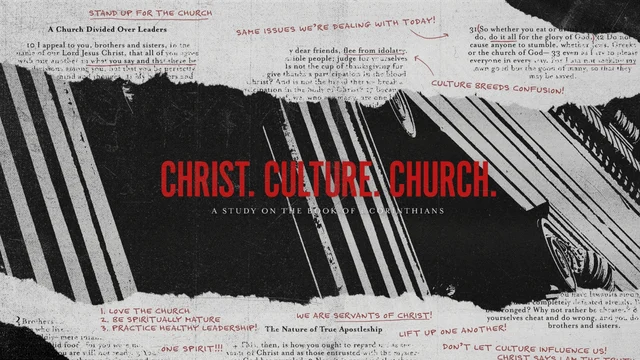
So we are in a series on First Corinthians. First Corinthians, and we have hit chapter nine. We’ve been walking through it, exposing the scripture a little bit and talking about how to be a church in a culture that is opposite of what a church is supposed to be. How do we have a gospel message that walks through the things that we face in this world? When I was in a youth group back in the day, and if any of you grew up in a youth group, if you’re a church person and grew up in a youth group, you’ve probably heard of this game where you build an obstacle course and you divide your youth group into two teams.
You pick one to be blindfolded, and you have another. That’s the voice that’s going to guide the blindfolded person through the obstacle course. The only trick here is the hard part is the other team gets to yell. The whole time they’re screaming and yelling while the person is saying, go right, go left. They’re just making as much noise as they possibly can.
That’s what the gospel message is that Paul’s trying to present. It’s the. It’s. It’s the direction. It’s the clear voice that we hear in the muck and in the messiness that guides us, the gospel that guides us through the cultural heaviness that we face, to give us safety, to bring safety to our hearts and to our lives.
And in First Corinthians, we’re cutting through that noise, and we are dealing with different sections of material. So we dealt with the first four chapters, which talked about how the Gospel heals the division and pride of a church. 5 and 7. Paul shows how the gospel gives clarity and moral and sexual confusion of their society. So we went through that last few weeks dealing with relationships and things like that.
This week, Paul was going to explain that the gospel can unite them even when they are culturally and politically separated. The church of Corinth was a pretty diverse group of people. There were a lot of Jews. There were a lot of Gentiles. There was rich, there was poor.
There were people of different walks of life. And those who were religious for years were there, and those who had just come to Christ. It sounds a lot like our church. A lot. A lot of different cultures, a lot of different people, a lot of different backgrounds, the way we were raised.
And we have this rosy picture of what a diverse church or unit, a diverse church looks like or a diverse people look like a unity that. That maybe movies give us or some kind of idealized way that. That. That we all come together and we all operate and think the same way. And.
But. But whenever you bring a diverse group of people together, there’s always tension, there’s always problems, there’s always hiccups. And the gospel is something that. That. The beauty of the gospel, it can bring us together.
It gives the. This diversity and this tension gives the gospel an opportunity to come forth and. And show its beauty and bloom from the muckiness and from the mess and show how good God is. And no human, no human system, no, no government can. Can bring people.
We’ve tried it, all right? We’ve tried everything we tried. We’ve tried to bring people together, but there’s still a mess. It’s still a mess. People still have a lot of tension, racial difficulties, political difficulties, divisions that happen.
But the gospel accomplishes through the death and resurrection of Jesus Christ that which cannot be accomplished in the world. So if you’re following along with me, pull out your Bibles or pull out the app and you can follow along in the app if you want to in the church center app. And we’re going to begin with verse 19 of chapter 9. And it says, for though I am free from all, for the sake of the gospel, I have made myself a servant to all. That word servant means slave.
It doesn’t just mean somebody who takes care of the household indentured servant. It means slave. It means the bottom of the bottom. It means someone who is owned by humans. It means somebody who is.
Who is in a terrible place. And this analogy would have been very, very familiar to the people in that day when he says, I have become a slave, meaning I have given up all of my rights. I’ve given up everything that I have a right to do in order for the gospel sake, I’d made myself a servant. I’m free for all. I’m free to do all but for the gospel sake that I might win more of them, that I might win more people to the Jews.
I became a Jew in order to win Jews. Well, that’s interesting. Paul was a Jew. How do you become a Jew when you’re a Jew? Well, sometimes he would have to play up his Jewishness and play down his Jewishness, depending on who he was talking to, where he was, and what the gospel called him to do at the time.
And then he says to those under the law, I became as one under the law, though not being myself under the law. He means, I’m willing to live culturally like those who keep the law and While I know that I’m no longer under the law, that I don’t want to become a Pharisee, or I’m not a Pharisee anymore, I’m like them. In order that I might win those under the law and to those outside the law, I became as one outside the law, meaning those Gentiles who were not under the law, who were not Jews. Paul was willing to live culturally like those who weren’t under Jewish law. He was willing to cast all of his culture and all of his political leanings and everything that he believed and was raised in order to reach those.
Now he says, I’m not. I’m not going to become a reprobate. I’m not going to throw out the moral law. I’m under the law of Christ, so therefore I still live in Christ. But I’m also not going to be stringent in my abiding by every single detail of law that comes from my Jewish culture.
I throw that out that I might win those outside the law. Verse 22. To the weak I became weak that I might win the weak. I have become all things to all people that by all means I might save what some. I might save just one.
I become all things to all people that I might have a chance to point them to salvation. And here’s the key phrase in verse 23. I do it all for the sake of the Gospel, that I may share with them in this blessing. 24. Do you not know that in a race all the runners run, but only one receives the prize?
So run you may obtain it. So he uses the analogy of a professional athlete here who gets rid of everything that keeps them from winning. That sheds all the fat and sheds all the weight off wearing Speedos. Shaving your arms and legs and wearing a funny cap is not particularly my type of style. But if I’m in a swimming race, I’m willing to throw that right out the door that I don’t have to wear those things.
I mean, I’d rather wear board shorts and a rash guard, you know, to swim. But if I’m willing to run a race, I’m going to throw those things to the side in order to win the crown, to win the trophy. Yeah, I gave you a good mental image there, didn’t I? You could thank me for that later as you’re thinking about it in church. Paul says, I have a right to do a lot of things in the Christian life, but I lay aside these things to help others see Jesus, to point people to Jesus.
Specifically in chapter Nine. Paul mentions three rights. Three rights that he puts aside. First of all, he says, don’t we have a right to eat and drink? In chapter eight, we see this controversy happening with meat blessed to idols.
So some people were saying, we do not need to participate in that. Don’t eat any meat. Because most of the meat in that day was blessed to idols in that particular area of Corinth. And they were. They were like, we don’t.
We need to basically become vegetarians because we’re. We’re worried about the meat that’s. That’s blessed to idols. Number one, it condones idol worship. And number two, it brings the power of these idols into your life.
Plus, there’s a whole lot of pork and a lot of meat that wasn’t pork. And Jews wanted. Was pork. Pardon? And they wanted to abstain from that because they were Jews, right?
It was under the law. But other Christians in the church were like, no, these idols, they’re really not gods at all. There’s nothing there. They’re just statues. They mean nothing.
And God’s power is stronger than any idol. And God’s death cleanses all of these things. And so. So just pass the bell, bacon. Let’s get on with it, because we are free in Christ.
And then Paul explains in chapter eight, in fact, he takes the side of the meat eaters. He says, the meat eaters are right. So he was team meat eater. He says, you know, you could. You can eat what you want.
Paul says, but if eating the meat will keep me from sharing the gospel with somebody, will keep someone from hearing the gospel, then I will give up those meat, that meat. I will give up food. I will give up drink. I will give up whatever. Ham, bacon, whatever it takes.
Even though that’s a great sacrifice, I’m willing to give that up for the sake of the gospel. I think about our context today when. When I. When I think about food, blessed idols or. Or whatever.
And how do I put it? I’ve been thinking about this a lot. How. How do I put it in the context? I’ve been thinking about this for years, in fact, because, you know, we don’t really have idol worship or anything like that, but I think about Thai food.
That’s one of my favorite foods. Man, I love Thai food. We got any Thai food people in here? Spicier the better, right? Very, very spicy Thai, spicy Thai hot.
They. They look at me, they see how white I am, and I say, I want number five. And they still give me number three or number two because they don’t think I can handle it. I know. No, put it on there, guys.
But for the sake of the gospel, how do I react in a Thai place when I know there’s a high percentage that, that, that food may be blessed idols because they come from a Hindu culture. They’re Buddhist, but they have a lot of Hindu mixed in, so therefore they, they worship other idols. Do I walk into the restaurant and I start looking at the menu asking, hey, is this blessed idols? Is this blessed idols? Is this blessed idols?
Let me go back in the kitchen and see if you got any idols back there. Because, you know, I’m a Christian and I don’t do this kind of thing, do I? Do I do that? No, no, because I think it would hinder the gospel message. So if I walk into a restaurant and I don’t know that whether that food’s blessed idols or not, I’m okay, I’m free to do that.
I’m free to eat that because I’m under Christ and idols are nothing anyway. They’re just wooden objects that are carved out. They don’t mean anything or precious metals. That’s all they are, because I’m free in Christ. However, if I walk into a Thai restaurant and there’s a worship service going on to the, to.
To the God of, of whomever, you know, and they’re blessing meat in front of me and doing all kinds of things, I’m going to have to pass. I’m going to have to say, for the sake of the gospel, I cannot be here because I don’t. It doesn’t look right. And I’m a follow of Christ and I put no other gods before me. So there’s.
So we walk through life thinking these things, you know, what, what is the line? You know, where can I go? Where am I free? And where do I need to sustain or abstain from those things? Is based on where you are in your Gospel Presentation, Verse 5.
Don’t we have a right to be accompanied by a believing wife? He gives us to another thing. You know, I can have a wife. Paul says, but you remember back in chapter seven, he says, I’ve not done that because I have a mission in this particular season of my life, and it’s best for me to remain single in this season of my life. It’s better for me because God has called me to something specific during this time.
But he says, no, I want a wife, but I’ve chosen not to have a wife. And in verse 12, it says, if others have a right to receive financial benefits from you. Don’t we? Even more meaning, don’t we have a right to receive payment from the church to live and to eat and to just have a life? But he says, or do only Barnabas and I have no right to refrain from working.
So they chose not to. Not to take a payment. Not because they couldn’t. Not because it was a bad thing to take a payment. They chose specifically not to take a payment because here’s what was happening.
There was a lot of slander going on about the church. These people were saying the apostles are going around making money and gaining power and that’s all they’re about. And he Knew that possibly 1900 years later a guy named Bart Ehrman would come out and say that’s exactly what the apostles were doing. There was nothing real about any of these stories. And it’s all a bunch of baloney.
It was all about money and power. And Paul says, I’m not going to let that get in the way. So I’m going to take a sacrifice here and I’m going to work while I minister. I’m going to be a tent maker and I’m going to make money. And me and Barnabas are going to do this for free and support ourselves so that there’s no hindrance in the gospel.
Verse 15. But. But I have made no use of any of these rights. What then is my reward? To preach the gospel and offer it free of charge and not make full use of my rights in the gospel.
So I do it all for the sake of the gospel. That. That. That’s my reward. He says, that’s.
That’s what I. I desire and I long for to see people know Jesus, to understand that they are lost without him, that everyone is lost without him. And there is hope in the power of Jesus Christ. A good example is. Is my life when I talk about forfeiting rights.
Most of you know that I’m not a drinker. I don’t drink. I don’t touch alcohol. But it’s not because. Because I think it’s wrong for you to have a glass of wine or a can of beer or whatever, you know, to settle down in the evening.
There’s. There’s nothing wrong with that. I, I could do that. I, I not. I don’t have an addictive personality.
I don’t have any issues with alcohol. So for me to do that, I. It would be okay. But I’ve chosen to abstain from any and all of that because of what our culture is up against. We have an epidemic alcoholism.
We have breweries that look like coffee shops and young people are getting addicted at early ages and families are broken apart because of alcohol and damage is done because of alcohol. People lose their lives on the roads because of alcohol. So I’ve chosen, I’ve chosen to abstain because of where my position is. And plus we have a lot of recovering alcohols and alcoholics in our church. We do.
And how would it look for me to be out there, you know, doing what I do, even if it’s, if it’s, it’s not wrong. Well, Pastor does it, I guess I can do it. I can just have one or I could be seen. And as you know, American church culture is, you know, in, in recent years, it’s a lot more liberal on the issues of alcohol. But in, in earlier years, people didn’t drink in church, you know, that, that were in church.
We chose to abstain from it back then because of all these things that I talk about, so I could be looked at as a hypocrite from other, from other people that probably believe in that point of view. I don’t want to have anything to do with church. Look at that pastor over there. So I’ve chose just to abstain from it. So certain rights we get rid of for the sake of the gospel.
How people see us and look us and look at us and perceive us. And then he goes on to talk about how an athlete exercises. He says an athlete who competes exercises extreme self control in everything. They do it to receive a perishable crown, but we an imperishable crown. It’s like I’m running a race for the soul of the loss.
And I’m willing to strip away anything and everything to get closer to my goal. I think of the training program of Michael Phelps. If you’ve read up on that, if you know Michael Phelps. Did you pop that picture in there? Yeah, there you go.
Michael Phelps. Isn’t he good looking? Yeah, right there in the water. All of you know Michael Phelps. Probably, I think every age group probably knows, knows Michael.
And he would swim 12 miles per day, every day, 1800 consecutive days without missing a single day to prepare for the olympics. He ate 12,000 calories a day. Pound of pasta for lunch, pound of pasta for dinner. And if you were, if you’re swimming 12 miles a day, you can eat anything you want. And he did it all for a bunch of records that one day would be beat or would be forgotten or trophies that would just collect dust in museums.
And someday my grandkids My great grandkids will probably not even know who Michael Phelps is. Some, probably today, have already forgotten who he is. So Paul says, if athletes train like they do for crowns that are perishable and names that fade away, how much more should we be willing to discipline our lives for the souls of people who last forever? What would we be willing to do? A crown we are striving for is not something that hangs from the rafters.
It’s a crown that’s everlasting. It’s a crown that goes after the souls of our neighbors and our co workers and our grandkids and everybody that needs to hear the gospel. And, and that’s the principle that he’s making. What are we willing to give up for the sake of the gospel? What are we willing to do even if it’s an okay thing, even if it’s permissible?
What are we willing to shed, to let go of so that somebody can see Jesus clearer? So I’m going to apply this in two different areas in the second half of this message. First to the church and second to us personally. Let’s talk about the church first. What do we need to do?
There’s things we need to think about as we move forward. We’re in a rebuilding season of our church and God’s doing some amazing things and we have a lot of new people that come in the door and a lot of them don’t know the Lord. Some of you today, you check, this is probably your first time in church a long time. Some of you are just giving church one last chance. And us as believers, us who are seasoned Christians who have been in church for a long time, need to look at ourselves.
So the first point I want to make, we must sacrifice preferences to reach the lost. What are we sacrificing? And sadly, the countryside of America is dotted with churches that don’t do that. They have furniture from the 1940s and music from the 1950s, and the pastor dresses like he’s from the 1960s. And they don’t want to change.
Why? Because it’s uncomfortable. It’s uncomfortable to change. I don’t like change. And it is for me too.
Change is hard. Even church I’m doing now, the church I’m leading is not the church I grew up in, not the church that I was comfortable in. And we need to, we need to be comfortably uncomfortable. Some of you grew up in churches like that. You, you remember those things.
How do you. How you now that you need to understand that this is, this is very, very possible even in our church, that this religiosity or this tradition creeps back in. We could do it easily as a newer church. We can get caught up in our ideas of church and how the light should look and how the drum should sound and how the worship music should be and not look forward and look ahead and see what others are doing and what our culture is doing and how to reach our culture. We can get locked into our ways as well.
It’s real easy to creep right back in to tradition. So how do we look at our church and what can we assess about our church that makes it open for those who don’t know the Lord, those who could see the Gospel clearly, to eliminate some of those things? Paul illustrates and applies this in First Corinthians 9 by having Timothy, his traveling companion, be circumcised. Because in that day, that was a very important law for the Jews, and they were ministering to Jews and. And Timothy was half Gentile and half Jew.
His mother was a Jew and his father was a Gentile, and he was never circumcised. And Paul argued for Timothy. He said, this is ridiculous. We shouldn’t be even dealing with this subject. It doesn’t have anything to do with circumcision, whether you have a relationship with Christ or not.
But in Acts, in the book of Acts, Acts 16, he asked Timothy to be circumcised. He had Timothy circumcised for the sake of the Gospel. And Timothy, he were here today, he would. He would be like, what in the world are y’ all crying about? The style of music or how somebody dresses or how somebody does ministry?
I had to sacrifice a lot here. I was an adult man that had to be circumcised. And y’ all are crying about how. How long the church service goes on Sunday morning. I mean, my goodness, imagine that.
We all need to be asking how we can best set up our church to reach more people for Christ. Always feel a little bit uncomfortable. We always need to feel a little bit uncomfortable in our church, right? The moment we get comfortable and everything goes perfect, or we think everything goes perfect, is the. Is the moment we need to begin to assess ourselves and see if we’re not allowing our needs fully to be met at the expense of those who are lost.
Second thing is, we must care not only about debt, but wit. A lot of Christians talk about their church and measures of doctrinal faithfulness. They’re like, you know, it’s deep, Pastor. This is a deep church, and we shouldn’t be worried about the width and who we’re reaching or who we’re, or how we’re growing or anything like that. It’s all about, you know, the depth of the Bible and our doctrine and getting all of that right.
And that’s what they say. But Paul was not satisfied with, with merely getting it right. Now, don’t get me wrong, we need to be deep, and I hope I’m doing that for you. We dig into the word of God. We preach every part of scripture.
We, we preach the hard things too, as you’ve learned in First Corinthians. We’ve gone through some pretty hard stuff, right? And we preach all of it. We talk about all of it. And doctrine is very important.
But what Paul saying, I don’t want to, I don’t want to get so focused on doctrinal issues that I forget what the real gospel message does. It reaches those that don’t know the Lord. And if we get too caught up in our doctrine, how deep we are and how, how far we go down into scripture and into our church and we’ve come in, become insider focus and not outside focus, then we, we, we lose the gravity of the gospel and the life changing message of Jesus. Charles Spurgeon said it like this. And if you know Charles Spurgeon, he was no theological lightweight.
He was a man who was one of the most important theologians in our history. And he said it like this. If my hearers are not converted, I feel like I have wasted my time. I have lost the exercise of brain and heart. I feel as if I lost my hope and I lost my life.
Unless I find for my Lord some of those blood bought ones, I would sooner bring one sinner to Jesus Christ, then unpack all the mysteries of the divine word. For conversion is the thing we are to live for. Conversion is the thing we are to live for. That’s how I feel. And of course we want to be doctrinally right and we want to grow deep.
But we’re not content in simply preaching truth accurately. We’re not content until we see people come to the saving grace of Christ. That’s what we’re about. And let me make it clear, it’s not us that save people, okay? It’s God that saves people.
The gospel has the power to save. And you’re not going to find hope in us. You’re not going to find hope in me. You’re not going to find hope in the people of this church. But the gospel message is that God sent his Savior.
All people are lost without Him. And he offers forgiveness and healing of their sins and restoration to new life for all that who come to know Him. Amen. Never forget that message. We can no more deny that than we could deny it.
And if in your heart you don’t yearn, something doesn’t drive you to want to see that, something doesn’t, doesn’t persuade you or pull you or convict you, if something doesn’t do that, then I have to question. I say this respectfully, I have to question whether you believe in the gospel at all. That’s the power of the gospel. And the third thing, we must seek to reach all people in Hampton Roads, not just one kind. Not just one kind of people.
It’s clear that Paul was focused on, on many different types of people. It’s clear that he wanted unity. He wanted a diverse church of different cultures, Jews and the Gentiles all together. But it was hard. It would have been a lot easier for Paul to say, you know, I’m going to plant the first church of the Jews over here on the west side of Corinth, and then I’ll plant the first church of the Gentiles over here on this east side.
And then we’ll come together for some, you know, events and come together for some outreaches. It would have been easier for him to do that, but he didn’t do that because that’s not what Jesus wanted to glorify. Jesus was to be in unity, that all people, all tongues and all tribes, as Revelation said, will confess his name. That’s Jesus. His throne will be over every nation.
And that’s what Paul saw. And he challenged the church to put some of their cultural preferences aside to reach others, because he knew that’s what Jesus wanted. And he says, to the weak, I became weak. So Paul’s saying, I’m theologically sound. I can go deep, but I became weak.
For those that are lost, I’m free to eat bacon. I’m free to refuse to do anything, but put a stumbling block between me and someone else. And I don’t want to do that. And he made all these cultural adaptations to reach people, and that was very, very hard. It’s just hard.
And as a church, we know that Jesus didn’t die for Republicans or political conservatives or white people or middle class families with children. He died for all people in all stages of life, of all economic levels. And he will be willing to turn, we got to be willing to turn down certain things, certain leanings, whether they’re right or wrong, for the sake of the gospel. And I’m telling you, that’s really hard. That’s very hard because this is the way we think, this is the way we’ve been raised and we believe that it’s right and we believe that we have the best method in which things can be solved and our nation can be healed.
J.D. greer wrote this Pastor’s Summit Church in Raleigh, North Carolina, Raleigh, Durham area, during the pandemic, during all the racial tension, he said this. One of our members of color who attended a black church for most of his life told me that growing up in times like these, the church was the one place he could go for refuge, confident that everyone there felt his pain, shared his anxieties and just understood. And church was the one place he could just be the trauma of slavery and Jim Crow laws created by solidarity and the black community, that served as a refuge in times of trial.
So he said when something tragic happened in the black community, he would expect it to be discussed at church that week because that shared pain and fear was one was on everybody’s mind. And choosing to come to a multi ethnic church, that is JD’s church, especially one where there was a majority of the members that were white, he said had given, had, had, had, he had given up that comfort because not every person in the church understands his worries. In fact, some seem primarily concerned to show how his worries and his pains were not legitimate. But he’s chosen to be a part of our community because he believes in the mission of the church. That’s hard when you have a mission to hold on to.
And here’s the truth. He shouldn’t have had to be the only one to adapt in that environment. JD goes on to say, for those of us in the white community, we too have to enter as much as we can into the culture of others to take on the burdens to listen to them. It doesn’t mean we say that their perspective is infallible or ours is wholly flawed, but it means we lay aside cultural preferences and perspectives and try to enter in with each other and remove as many barriers as possible to lay aside whatever we can for the gospel. We do it all for the sake of the gospel, that we might save some.
And it also means that we have to be muted at times on certain issues, quiet at times, certain issues. That’s what Paul did. He was quiet and muted on secondary convictions in 1 Corinthians 8, 9 because the unity of the church and its evangelical mission was more important than his views and the uniformity of perspectives in all Things. Different perspectives are going to be different perspectives, and it’s good to have different perspectives. That’s what makes the gospel so beautiful, that we can come together believing and acting on different things.
As a church, we may say too much about one issue and not enough about others, and people will be upset in some way or some regard. So I’m not saying that everybody’s going to be happy. I’m not saying all perspectives are equally valid. And I’m certainly not saying we are ever muted or unclear on the things we do stand on as far as sanctity of life, the evils of racism and equality under the law. We are very clear and we are very open about those things.
I’m saying there are times that a particular perspective on the best way to set up society and the opinion of the best people to take us there may not need to be spoken out loud. In certain situations. It doesn’t mean that we’re right or we’re wrong. But sometimes we need to dial it down a little bit for the sake of the gospel, that when we come together, there are certain issues that we just we’re going to believe are important. But for the sake of the gospel, we’re muted at certain times and we’re quiet at certain times.
Now, I’m not saying that we shouldn’t get involved in politics. By all means. We need more Christians in the political world to take up for those who are less fortunate than us to create opportunities for prosperity and. And individualism and all those beautiful things that we as Christians can promote. We can promote the gospel through those things.
But there’s times where we’re just going to have to be a little quieter. We’re going to have to dial it down a little bit for the sake of the gospel, give up those rights for the sake of those who don’t know the Lord. We see a great example of this in the Bible. They do this right here in Acts 15. Jews and Gentile believers stopped worshiping together because they didn’t like each other’s cultural and political positions.
That sounds very familiar. Divided then as well as it is today. Because people, when you get them together from different cultures and different backgrounds, this is how they’re going to be. And they basically said in Acts 15:29 that the Gentiles should. And this is very interesting.
Okay. They come to the conclusion, all the church leaders came together and came to the conclusion that. That first of all, the Gentiles should avoid sexual immorality and avoid eating things that had died by strangulation. Of all the Jewish laws, why this one? The food that had been strangled, do not eat that.
And James explains the reasoning for these two regulations. He says, for from the ancient generations, Moses has had an ancient every city, those who proclaim him, meaning those that are Jews. So we need to be careful what we do. Because what was happening is Jews were showing up at church and there was a bunch of gentiles out in the parking lot barbecuing, strangled gopher. And they were coming up and they’re like, what in the world?
This is making me sick, right? I’m not coming to church. Oh, how could we do that? They couldn’t stomach it. And the apostles said, yes, you gentiles have a right to, to eat choked gophers if you want to, but when you’re at church, let’s forfeit those rights for the sake of the Jews and those that are coming to Christ.
And James, the leader of the church, wrapped it up by uttering one of the most important phrases I think that we should etch on each and every one of our hearts. He says this. We should not make it difficult for the Gentiles or Jews who are turning to God. We should not make it difficult church. Let’s not make people coming to Christ difficult.
Plaster that statement on your heart. Live that out. Think about that as you’re walking in life and sharing the gospel. Are we making it difficult? As we grow and mature in Christ, don’t make it hard for whites and blacks and Asians and Latino seekers and anybody and everybody in between.
We have a gospel too precious and a mission too urgent to let anything stand in the way. An urgency for the gospel. We do it all for the sake of the gospel. The gospel of Jesus Christ. Amen.
And finally, for you personally, not just the church, but you personally, what do I need to give up? That’s the question you need to ask. What do I personally need to give up for the sake of the gospel that I have a right to, but I should give up for the sake of the gospel? How about your career? Let’s talk about career for a second.
Let me ask some questions here. Have you thought about how your career might contribute? Some of you have been given jobs that carry you into places that are hard to reach the gospel. Maybe you feel like you’re called to the mission field, to places where you can share Jesus, that I can’t go here, Right? Right here in Virginia beach.
You are in places that I can’t go. You’re connected with people in the workplace and in your Everyday life. And you’re the only bible that some people will ever hear. When they see your life, they see your heart, they see your love for Jesus. And some of you have.
Have jobs that can transfer less fortunate people groups around the world. An example there was a guy who runs a CrossFit gym and North Africa. So they go out there and minister to people in North Africa. Another guy who’s an engineer, an engineer firm in, in South Asia. A girl who’s a counselor who works with abused victims in the red light district of India.
Not because it’s convenient, not because it’s going to give them some sense of. Of comfort. Obviously not. They do it for the sake of the gospel that what some might be saved. I’m willing to give up my comfort, take my career, what I’m good at, to share the gospel, my money.
Are you spending your money in ways that benefit the urgency of the gospel? We are we given like we really believe that heaven and hell are real and the mission of the gospel has to go out. It’s urgent. Ask yourself, if Jesus came back tonight, would you say that I had given all that I could to the urgency of that gospel message going out before he returned? Lifestyle.
What, what lifestyle changes do you need to make to free up your bandwidth? To. To give more if you you’re not able to give more or minister more if you’re not able to minister more or volunteer more if you’re not able to volunteer? My culture can, can you critique your own culture? That’s what Paul did.
He critiqued his own culture. He saw the flaws in his people and he knew the problems with, with the abiding under the law so rigidly that kept the Gentiles away. What, what, what is my culture taught me? What do I need to remove? What my.
What preferences do I need to change? Leslie Newbiggin said it like this. A true test of Christian maturity is the ability to allow the gospel to challenge my culture. Allow the gospel to challenge your culture because Paul’s commitment to Christ outweighed any commitment to Israel. Don’t get me wrong.
I love America. I love the land of the free. I’m as patriotic as you’ll get. But I’m willing to sacrifice all of that for the sake of the gospel. My opinions.
Is their opinion that you need to dial back so as not to be a distraction to the gospel. My preferences. What preferences do you need to forego to create environments better to reach people? Are you really willing to be a part of a church where you feel uncomfortable Are you really willing to be a part of a church where, you know, things not, might not, might not work your way or might not be the church that you always have been accustomed being a part of? We experience that all the time with people because we are a mobile church for so many years and we’ve reached all kinds.
I’m getting a giggle over here. We have, we had, we had one couple come and they lasted maybe six months because they just could not get over all, you know, some of the people that you’re a man. If people don’t have problems in your church, then you’re not doing something right. Okay, new Christians, new believers, they’re going to have problems. And, and they’re like, we just can’t take it.
Pastor. We’re going back to our traditional church because, man, I wanted to reach people for Jesus, but this is hard. And it is hard sacrificing our presence, our preferences, getting comfortably uncomfortable or my circle, my circle of friends, my circle, my, my, my. We like to go home and, and chill out and eat and, and watch TV for a while, go to bed. Don’t.
I don’t want anybody in my life, you know. But are you willing to invite somebody over that’s not like you, that’s different than you? Maybe somebody unchurched and just love them and are we willing to bring them into our social routine to better communicate the gospel, to share the gospel? Our social circle circles our social rhythm and my invite, my invite. Whom could you invite to start reading the word with you, to come to church with you?
Easter’s coming. Easter’s coming. Before you know what, Easter will be here? Who are you inviting? It’s time to start praying about that, right?
Who am I going to invite to church? Easter? Who’s, who’s the five people? I’m going to give you a, a mandate. Five people you have to invite to church for Easter.
One of the, one of those months, one of those times of the year where you have a much greater chance of somebody saying yes to church. Just salt as we, as we land here and as the music comes on. Do you not know that’s what Paul says? Do you not know that in a race all the runners run, but only one receives the prize? So run that you may obtain it for that prize.
Athletes who compete exercise extreme self control in everything. We need self control. We, we have to be disciplined. We have to see the vision, we have to see the focus. We have to see Jesus.
We run with perseverance towards Jesus. Amen. Hebrews says that we shed off every weight. We shed off everything. We set off every sin, every obstacle so that we run with perseverance.
Athletes who compete at exercise self control, they do it to receive a perishable crown, but we do it why? Not to receive any accolades in this life, but that we please God our Father, that we receive an imperishable crown, crown in heaven. Amen. That should be our goal. I want you to take a minute as we close here and think about this.
Imagine being in heaven. Imagine being in heaven one day, 10,000 years. You’re, you’re, you’re in the new heavens and new earths and, and you, you develop friendships that you didn’t know in this earth. And you have one. It’s just a really, really close friend of yours.
Really, really close friend of yours. You just can’t. I mean, how could I have ever had a friend like this? Never had it on earth. And, and as you’re talking, you discover their story.
When they were on earth, when, when before the Lord returned and made all the things right. They remember that, that, that, that opportunity to receive the gospel. And you’re like, wait a minute, I was a part of that process. I was a part of that process. I gave or I served or I put something into something.
And that was a part of the method in which brought this wonderful person to the gospel of Jesus Christ. Isn’t that something worth striving and running for? Isn’t that worth everything that we have to know that somebody knew Christ, that someone was saved because of the little things that we’ve done? That should be our heart. That’s why we practice self control to receive that perishable crown, that received that imperishable crown rather.
You’ve probably never heard of Mary Clark. Mary Clark was well to do, lived in Beverly Hills, California, a very comfortable life. And God started burdening her for the prison systems, those people who were broken and hopeless. She started doing prison ministry. And as she was driving home to her comfortable house and her comfortable situation, God began to just burden her like, like this is a real obstacle.
So she goes to the prisons, the prison system and asks for a 10 by 10 cell that she would live in for years and years and years, become one of them. In fact, they called her the prison angel. They would have fights and all that kind of stuff happening in the prison and guns and knives and all kinds of stuff. And she’d walk in the room and everybody stopped and looked. That’s how much influence she had because she became like them.
She forfeited those things, those pleasures in life for the sake of the gospel. I’m not telling you this is a new strategy for prison ministry. And I don’t even think the min. The prison ministry would even. I mean, prisons would even allow you to do that.
But history has been changed by people willing to do whatever they could do for the sake of the gospel so that they by all means might save some. Question is, are you willing to forfeit some things? Can we be a church of different types of people from different cultures, different backgrounds, different political leanings, but could come together for the sake of the gospel? That we forbid our rights for the sake of the gospel? Can we pray?
Father. Thank you, Lord, for your word. God, challenge us today. Challenge us to think differently. Paul challenged us.
He said, I’d be willing to do all things. You need to be willing to do all things in anything for the sake of Jesus Christ. Because we are servants of Christ. We are slaves to Christ. That we forfeit every right that we have.
Lord God, help us see that clearly. Help us understand that. Begin to convict our hearts today. Lord, people in here right now speak to them. Lord, what’s the Holy Spirit saying to you here today?
What do you need to give up? What do you need to ask the Lord to help you in God? I pray the Spirit of God would speak clearly to the people here today as we grow this church, as we reach out more sake of the gospel for some people here today with all heads bowed and eyes closed. You’ve never given your life to Jesus. We’ve all done wrong.
We’re all sinners. We all fall short of the glory of God. That’s what scripture says. You can’t be a good person to get to heaven. It’s not how it works.
Because none of us are good as Paul says. No, not one. We’ve all sinned in some way. Small sins, big sins. But that’s the glory of Jesus Christ.
He came to give you life. He came to save you, to save you from your sin. And if you ask him into your life and into your heart today, he will come in and he will make his home. Behold, I stand at the door and knock. And if anyone hears my voice and opens up that door, I will come in.
Would you open up that door today? If that’s you? Would you pray this with me? Father? I believe that you are the Son of God.
That you died on the cross for my sin. Come into my life, Lord. Make me a new creation in you. I never want to be the same again. I never will be the same again because of you, Jesus.
Thank you for saving my soul. In Jesus name, amen. Hallelujah. Praise God. Praise God.
If you’ve gave your life to Jesus today, put it on that blue card. Turn it in. We’d love to connect with you if you rededicated your life to Jesus today. Amen. Just as important, check off that box on that card and let us know that you rededicated your life to.
To Jesus today. I’m so thankful that you are here with us. And I can’t wait till next week till we get to the next part of our study of First Corinthians. I will be glad to see you outside under the tent. If you’re new with us regulars, if y’ all will give me an opportunity to talk to the new people, I would appreciate that.
All right. Thank you so much. God bless. Y’ all have a great week.