 Play this video
Listen to this messageDownload MP3
Keeps playing while you browse the site.
Key Points
- Introduction of the Four Cups connects Jewish Seder and Last Supper, highlighting God's promises made to Israel over 3,000 years ago.
- God's 'very great and precious promises' discussed in 2 Peter 1:4 enable believers to escape worldly corruption and participate in divine nature.
- Emphasis on the unchangeable nature of God's promises, with Hebrews 6:17-18 affirming their reliability as spiritual lifelines.
- Salvation, defined in Exodus 6:6-7, is presented as a personal relationship with Jesus, not just church membership or attendance.
- Discussed salvation as an act of God's grace as described in Titus 3:3-8, emphasizing it’s about restoration and a genuine relationship with God.
- Addressed that many Christians (estimated 80-90%) remain in bondage to sin despite having salvation, highlighting the need for deliverance.
- Third promise focuses on redemption and restoration, using Ephesians 1 to illustrate believers finding identity and purpose in Christ.
- Fourth promise speaks to community and fulfillment as outlined in John 10:10, shifting focus from individual needs to collective identity.
- The concept of transcendent need, beyond self-actualization, ties into spiritual purpose as discussed through Maslow's hierarchy.
- Future marriage feast in heaven portrayed as ultimate fulfillment, marking the promise of eternal life with Christ.
Questions & Answers
What does it mean to have faith?
Having true faith involves trusting in a higher power and believing in the possibility of growth, purpose, and guidance beyond what we can see. It provides strength during difficult times and encourages us to hold onto hope and integrity. Faith is the confident trust in something greater than ourselves, even when we cannot see or fully understand it, and it gives life purposeful direction by encouraging belief in positive outcomes and moral integrity. As expressed in scripture, such as Hebrews 11:1, faith is the assurance of things hoped for, the evidence of things not seen. It reminds us…
Read the full answer →How can I find purpose in my life?
Your purpose in life is unique and divinely designed, involving living out your calling in a way that honors your identity and impacts others positively. It often comes from aligning your talents, passions, and values with a sense of service or contribution. Recognizing that you are chosen and that your existence has meaning beyond yourself can help anchor your purpose, guiding you to contribute positively to the world around you. Reflecting on what truly matters to you and living authentically in accordance with your core beliefs can lead to a fulfilled life. Understanding your purpose…
Read the full answer →How can I overcome life’s challenges?
Overcoming life’s obstacles with faith involves trusting that challenges serve a purpose in personal growth and spiritual development. Faith provides strength, patience, and perspective, reminding us that difficulties are not permanent and that perseverance leads to transformation. Believing in a higher plan can give comfort and motivation to keep moving forward, even in the face of adversity. Scriptures like Isaiah 41:10 offer reassurance: ‘So do not fear, for I am with you; do not be dismayed, for I am your God.’ Recognizing that difficulties are part of a journey for growth can motivate…
Read the full answer →How can I improve my relationships with others?
Healthy relationships are built on qualities like empathy, respect, genuine care, trust, understanding, and forgiveness. Treating others with kindness involves listening actively, showing compassion, and forgiving mistakes—both others’ and your own. Recognizing the shared human experience and that everyone is imperfect fosters understanding, patience, and mercy, leading to more meaningful interactions. Practicing gratitude, seeking to serve others, and cultivating love and understanding creates meaningful connections and supports growth and resilience through life’s challenges. Scriptures…
Read the full answer →How can I find hope during difficult times?
Hope remains available even amid life’s messiness because it is rooted in the belief that difficulties are temporary and part of a larger purpose. Many spiritual teachings remind us that setbacks, failures, and hardships are opportunities to grow stronger and more resilient. Just as a community or person is in a constant process of becoming better, our hope encourages us to trust that things are not final. There is a divine purpose working behind the scenes that sustains us, even when we don’t see immediate results. Hope arises from believing that challenges are temporary and that better…
Read the full answer →What role does morality play in a fulfilling life?
Living morally plays a significant role in your daily life, as it involves making choices based on principles of right and wrong that promote respect, honesty, and kindness. When you act with integrity, kindness, and fairness, you build trust and strengthen relationships, which contributes to a sense of inner peace. By living morally, you foster a life aligned with higher principles and shared human values, and you help create trust and harmony in your relationships and community. This guides you to act with integrity and consideration for others, ultimately contributing to a peaceful and…
Read the full answer →What does forgiveness mean, and why is it important?
Forgiveness is the act of letting go of resentment and choosing to release hurtful feelings toward others or oneself. It is vital because it frees us from the burden of bitterness, allowing healing and reconciliation to take place. Forgiveness does not mean forgetting or condoning harmful actions, but rather choosing peace over anger. It restores relationships and helps us move forward with a lighter heart. Forgiveness involves releasing feelings of anger, resentment, or hurt towards someone who has wronged you, and it promotes healing—for yourself and others. It fosters reconciliation and…
Read the full answer →Read the transcript
I’m going to talk today about something that I actually did a whole series on years ago, and I’m trying to compile it into one, one message. But I thought it was really important that we look at the promises of God and the Jewish Seder, in which we see, even on the Last Supper, the day of the Last Supper, the Passover celebration that was taking place, there were different Seder means steps. So there were steps that took place, place at the Last Supper. You may think of the Lord’s Supper as what you have in your seat. You may think of it as a glass of, or a cup of, or whatever it is, based on your tradition.
We had those little glass things when I was growing up. You know, the nice glass communion. They’re really fancy. So. And we would have these gold plates and they would.
They would pass them around and everybody would take a bread and all that. And some of you grew up maybe in a liturgical tradition where you came up front and partook of the bread and the wine. Some of you it was wine. Some of you it was grape juice, depending on your tradition, if you’re teetotalers. So there’s all kinds of traditions.
And that’s normally what we think of when we think of the Lord’s Supper, that Jesus just had a cup and he had bread. But there was a lot more going on during this. There were actually four cups that took place. Four cups that took place. And we’re going to talk about that today.
More than 3,000 years ago, God made some promises to Israel, and we’re going to look at those promises. Those promises still apply to us today. They’re available to us today as a church. We have them available to us. But let’s look at that Second Peter.
If you have your notes, there’s a piece of paper there if you want to pull that out. Or you can go to the Bible app, find Salt Church, and you’ll see the notes there as well. In Second Peter, chapter one, verse four, it says, God has given us his very great and precious promises. He’s given us some great precious promises. Amen.
So that through them you may participate in the divine nature and escape the corruption in the world caused by evil desires. See, a lot of Christians are missing out because they’re living natural lives. But we were never intended to live just natural lives. We were intended to live supernatural lives. We were designed for something supernatural.
We have this spirit man inside of us that lives forever. So we aren’t just, you know, physical people that are having temporary spiritual experiences. We’re actually spiritual beings in a temporary physical body. And God has so much more for us. And his promises are spiritual weapons that we can use to escape the corruption of this world.
We have that available to us, the desires, the corruption of this world. We have these promises available to us. And what is a promise? Here’s a good definition of a promise. Promise is an offer with a guaranteed result that is iron tight.
It’s going to happen. But some of you are probably like, that’s not a promise because maybe you’ve had a broken promise. We have a skewed idea of promises because we’ve seen promises broken. We’ve been hurt by people. Somebody said, I’ll be with you always or till the end.
Or maybe it was a business partner, maybe it was a family member. We’re blood and we’re always going to be there with you. But you just, you learn that that’s not the case. And maybe your heart was broken or till death do us part, that promise was made to you, but that didn’t happen. And we have this skewed idea of promises.
But God’s promises aren’t like that. God’s not like that. When he makes a promise, he fulfills his promise. It’s iron tight. He cannot change.
And when his promises are put forth, he is not going to skew from those promises. They are there and you can trust in them. Look at Joshua 21:45. Not one of all of the Lord’s good promises to Israel failed. Everyone was fulfilled.
Every promise that was made to Israel was fulfilled. And while they were living, they thought that God wasn’t fulfilling the promises. Maybe you’re there right now, you’re waiting for that promise to be fulfilled. And you’re like, well, God, you haven’t come through for me. I don’t see you working.
What’s going on, God? I, I don’t know what in the world you’re doing and I want to know what you’re doing. And maybe you’re there in your thought process, maybe you feel that way. But I can assure you God is fulfilling something in the background. He’s got promises available to us that he’s filling in the background.
Look at Hebrews 6, 17, 18. I love how the message says this. It says, when God wanted to guarantee his promises, he gave his word. A rock solid guarantee, a guarantee that will not change. God can’t break his word, meaning God’s nature can’t break.
I love how the message puts that together. And it says this. And because his word cannot change, his promises or his promise is likewise unchangeable. We who have run for our very lives to God have every reason to grab the promised hope with both hands. We can grab it with both hands because we can be assured.
That’s an anchor. Like, his promise is an anchor that we can. We can hold onto, and we can and never let go. There’s an old Matt Redmond song that was like, oh, no, you never let go. And that’s, you know, he never lets go of us, right?
And we can hold onto that promise that he never lets go of us. We don’t let go of him. And we can hold onto it, never let go. And it’s an unbreakable spiritual lifeline, reaching past all appearances, right, to the very presence of God. That’s God’s promises for us.
But you need to know a few things about what a promise is, especially before we go into the four cups, which are four promises that are laid out for us. But what is three things about a promise? First of all, you need to know his promises. You need to know his promises, because there’s a lot of promises. There’s hundreds of promises in the Bible.
Did you know that? And they need to be made known to you. 1st Chronicles 17:19 says, O Lord, for the sake of your servant and according to your will, you have done this great thing and made known all these great promises. He makes them known to you. He has them laid out to you.
Where do you find them in the Word of God? If you’re not reading your Bible, you don’t know the promises. You need to get into the Word of God and dig out all those hundreds of promises that are available to you every day. You need to be in there, just learning about God, pulling, knowing his promises. When life doesn’t make sense, you can always go to the promises of God.
For instance, if you’re fearful, you can go to Psalm 127. The Lord is my light and my salvation. Whom shall I fear? I have nothing to fear. Amen.
When I feel like the devil’s attacking me on every edge, what can I say? First John 4. 4, Greater is he that is in me than he that is in the world. That is a promise. Romans 8:37.
Know that in all things God has made me more than conqueror through Christ who loves us. Amen. Luke 10:19. I have been given authority to trample on snakes and scorpions. I have been given power over all the enemy.
Nothing shall harm me when I have financial struggles. Philippians 4:19. God shall supply all of my needs according to his riches and glory. Amen. And when I need healing, Psalm 103 bless the Lord all my soul Bless his holy name who heals me of all my sin and all my disease when you’re feeling alone.
Deuteronomy 3:31 and Hebrews 13 I will never leave you. I will never forsake you. He will never leave you. He will never forsake you. So I need to know his promises so I can hold onto those promises.
And. And I need to understand his promises is the second point. Not only need to know Him, I need to understand them. And you may think God doesn’t really fulfill his promises and it doesn’t make sense to you. And maybe it’s false advertisement because of all the muck from the promises that have been broken in your life, the people that have hurt you in your life.
But let me tell you something. You can’t sin enough. You can’t be far from him enough for his promises not to be available to you. That his promise of salvation is available to you at any point and it’s unconditional, but there’s conditional parts to it as well. I need to walk in a right relationship with God so that I can lean into his promises.
Amen. And you also need faith. You have to have faith that you can put and place your trust in his promises, that you believe with all your heart that his promises are there and he does it his way in his time. He doesn’t do it in your time. If your promises haven’t been fulfilled or those promises that have been laid out in your life haven’t been fulfilled yet, you need to hold on and trust God and lean into that.
That in his time it will happen. Second Corinthians 1:20 says, for no matter how many promises God has made, they are yes in Christ. And so through him, the Amen is spoken by us to the glory of God we can trust. Yes and Amen. When we say amen in our prayers, it means, so be it, God.
It is going to happen. God, we believe it. Go because your promise says so. God, we believe in confidence that he is. His promises are with us, and we need to pursue his promises.
Third thing, we need to pursue his promises. Are you pursuing his promises when you see that promise? Are you going after it? Are you chasing it down? David did that.
He said, your promises have been thoroughly tested and your servant loves them. In Psalm 119,140 he tested them. He claimed them. He saw them. He ran them through, and you claimed them.
And they didn’t happen, maybe in your life, and you walked away from it. Can I say maybe you need to pursue them. Turn around and just pursue them again. Test them. And he loved them.
David said this in Psalm 119,148. He, he says this, my eyes stay open through the watches of the night that I may meditate on your promises. Can you imagine that? Just meditating. He just stayed up all night meditating.
What a love for God’s promises. How many of us stay up meditating, stay up all night just thinking about how good God’s promises are. Even in the midst of all the muck of life and all the things that go on in life, you can pursue his promise. And if you do, it’s a guarantee you can experience more than you are currently experiencing. That’s my hope today, is that we don’t just get saved, get some fire insurance, but that we actually experience God at a whole new level.
We experience his presence, his power, his purpose in our lives. And that’s what God is sharing with us through the Israelites when he has these four core promises that we’re going to talk about in this next part. Four core promises. And although there are hundreds of promises in the Bible, you can take all the hundreds of promises and put them under these four. These four are the core promises that God made to Israel.
If you’re following along Exodus 6, 6 and 7, many of you are familiar with this passage. And it has four different things here. It says, therefore say to the Israelites, I am the Lord and I will bring you out. There you go. Underline that.
I will bring you out. I gotta get you out. I just gotta get you out. And from under the yoke of the Egyptians. And I will free you.
I will get you out and I will free you from being slaves. Isn’t it that when you get me out, you’re free? But. But. Well, he got them out of Egypt, but Egypt wasn’t out of them.
And sometimes we got to get to Egypt out of us. Amen. And I will free you from being slaves to them. And I will redeem you with an outstretched arm and with mighty acts of judgment. And I will take you as my own people.
I love how he goes from you to people. And I will be your God. And then you will know that I am the Lord your God, who brought you out from under the yoke of the Egyptians. So let’s just deal with the first promise there. The Lord said, I will bring you out.
So when the Seder took place and they Gathered together at a meal, Passover meal. They would start off with that promise. They would start off with that cup. They would drink the cup before they even participated in the supper and in the different elements of the supper. And it represented that God promised me salvation.
God promised me salvation. They call it the cup of sanctification to be set apart. God pulled them out. See, salvation isn’t just church attendance. Salvation isn’t checking off a card.
Salvation isn’t being a part of a denomination or some type of church structure. That’s not being a Christian. That’s not being saved. That’s not being taken out. That’s not salvation.
I have a neighbor that I talk to often, and I’m always trying to work on him a little bit, work on his heart, because he’s far from God. But we have those talks sometimes. And I think the first time we had the spiritual talk, I said, are you a believer? He says, I’m a Baptist. I said, okay, but, Art, do you know Jesus?
Do you believe? You know, do you believe in Jesus? Well, yeah. Yeah, I grew up Baptist. I grew up Baptist.
And then, you know, he goes on to curse about 20, 20 times in one sentence and talk about, you know, whatever it is that he doesn’t care. I’m a pastor. He just, you know, that’s just who he is. Embarrass his wife to death. I know that.
But that’s not what Christian being a Christian means. Being a Christian means that you have a relationship with Jesus, that you believe in Jesus, that you know that he died on the cross for your sin. He comes into your life. It’s not just saying a prayer. It’s believing it in your heart and confessing it with your mouth.
And if you’re today here and you haven’t given your life to Jesus, if you haven’t made him Lord of your life, you can make him Lord of your life, life today by just believing and trusting in him that you cannot be good enough. You cannot be good enough. Your relationship to Jesus doesn’t depend on how good you are. Your relationship to Jesus depends on how good he is. And he’s perfect and he was broken for our sins.
Please hear me. Whatever tradition you grew up in, whatever denomination you grew up in, maybe you were not even in a denomination, maybe you’ve never been to church before. But can I tell you with all my heart, with everything else that’s in me, like, Jesus loves you and he wants a relationship with you. You don’t have to take a bunch of steps like in the Old Testament to get there, the veil is open and he’s available to you. He can rescue.
He can pull you out. The cup of salvation. The cup of salvation, or sanctification, rather. He. He promises us sanctification, salvation.
He sets us apart. Look what Titus says here. Titus 3. 3 8. Paul says this.
It wasn’t so long ago that we ourselves were stupid and stubborn. Eugene Peterson’s translation here, by the way, using the message a little bit today, just to make it a little more for you, okay? Dupes of sin, ordered every which way by your glands. It means like your flesh. Flesh was involved in everything.
You just followed your own way, going around with a chip on our shoulder. Hated and hated and hating back. Some of you were there. You hated everything. You’re hating.
People were hating you. When you walked in a room, it wasn’t good. But when God, our kind and loving Savior, stepped in, he saved us from all of that. That’s the truth. It was all his doing.
Nothing that you did. That’s the unconditional love of Jesus Christ. It was nothing that you did. And I love this next part. He says, he gave us a good bath.
Some of you needed a spiritual bath, and he gave you a good bath. And we came out of it. New people washed inside and out by the Holy Spirit, our Savior. Jesus poured out new life so generously, and God’s gift has restored our relationship with him and given us back our lives. And there’s more life to come.
See, it doesn’t stop there, right? It doesn’t stop with just saying a prayer. And now I’m a Christian. But he’s got more life to come, and you can count on this. Salvation is more than just church attendance.
Salvation is more than just checking off boxes. Salvation is having an authentication relationship in love with Jesus Christ and walking with him every day. But there’s more, as the scripture says. And here’s where a lot of Christians get stuck in the second cup. Second cup.
We call this the cup of deliverance. God promises me deliverance. He promises you deliverance. That’s why it says, I will free you. Some of you read that passage, I’m sure, and thought, well, aren’t we taken out?
How can we be freed but yet need to be delivered? How can we be free yet still be slaves? It’s very easy. There’s many Christians today that are slave to their sin. They’re slave to their addictions.
They’re slave to. To their. Whatever they have from their past that’s just there. They’ve never gotten rid of it. And they live in the misery of their past.
They haven’t been rescued, they haven’t been delivered from it. They’re still in bondage to their sin. I would say about 80 or 90% of Christians are probably still there in that camp. There’s a lot of people that are still just settling for, I’m saved, but I’m going to live my miserable saved life and kind of work on that. My one thing that I’m going to have to deal with the rest of my life, I’m never going to be able to get rid of it.
It’s just so hard. And God wants more you. He has deliverance available for you. And some of you are like, wow, when I hear that word, deliverance, you kind of automatically connect it with deliverance ministries. Like you’re saying, are you talking about, like, we got all demons in us and we need to be delivered or whatever?
No, that’s not what deliverance is. Yes, there are times demonic forces are working and acting in people and hurting people. But. But it simply means that you’re trapped in your old life and you haven’t been delivered from your old life. You still have problems, and you can’t get past those problems.
And Paul confessed it himself. He said in Romans 7:25, he said, so then, I myself, in my mind, am a slave to God’s law, but in the sinful nature, a slave to the law of sin. Therefore, there is no. What condemnation? There is no condemnation for those who are in Christ Jesus.
Because through Christ Jesus, the law of the spirit of life set me free. So a lot of people stop there in the first part, like, oh, Paul was dealing with it. I guess I have to deal with it too. But he says, man, I was set free, though I was set free through Jesus Christ. I was set free from the law of sin and death.
He took me. You have no more condemnation. There’s no condemnation on you. You can be freed. You can be rescued.
You can have victory over sin. You can have healing of your wounds. You can have the authority, authority over the enemy. You have authority. Jesus has given you authority over your sin.
Jesus has given you authority over those things, those things of bondage that you just haven’t been able to break free of. It is available for you. And there’s so much more for you. On the other side of that, Christianity isn’t just saying a prayer and going to church. It’s so much more than that, that God has so much more for you.
Which leads me to the next step, the third Cup. He says, I will redeem you. I will redeem you. God’s promise is to restore you. Not only does he want to free you, pull you out and free you, he wants restoration in your life.
I think about restoration, your car restoration, old car restorations. I love going to car shows and looking at these cars, you know, and it looks like they just been. They’ve come off a brand new parking lot. People put so much work. And these old.
I love Broncos. I love looking at the old Broncos. And I’ve got a guy in my neighborhood, he’s got brand new seats and floors and it’s just, you know, steering wheel, it looks just like it came off the parking lot. It’s just so amazing. And that they can do that.
They can take an old car, rust and damage and tears, and make it new, make it look new. It’s just incredible. But God does even more than that. You know what he does? He doesn’t just make the old person new, he makes you brand new.
He makes you brand new. He restores you completely to newness. That’s why you are made a new creation in Jesus Christ. Right? He can make you a new person.
You don’t have to be the old person anymore. You, he makes you new. He restores you. Ephesians 1 says it like this in the message. Once again, I know I’m using the message a lot today.
Some of you are like, oh, I don’t like those message passages. Well, get over it. We’re using it. Okay? Because I think it’s fun sometimes to throw the message in here.
Self righteous people, right? I don’t use a paraphrase. I use the real scripture, you know, King James Version. Yeah, King James only. It’s in Christ that we find out who we are and what we are living for.
It’s in Christ that we find out who we are. Some people don’t know who they are and they don’t know what they’re living for. I don’t have any purpose. People are looking for purpose. But Christ Jesus shows us purpose in living.
He said long before we first heard of Christ and got our hopes up, he had our eyes on us. He already knew how he made us. He put us together, every little piece of us. Our mother’s womb. He was piecing us together.
He was learning about what gifts we would have that he would bestow upon us. He knew what kind of personality we were going to have. He knew the passions. Yeah. Some of you are like, oh, you know, my personality needs to be restored.
I can tell you this. I can tell you this. God made your personality just perfect. Sin got in the way and used it in the wrong way. But I’m going to tell you, God wants to use your personality and do well with it.
He’s going to use you. He’s going to fully restore you. He knew your personality. He even gave you passions. And we as a church try to help you find those three things.
Gifts, your gifts, your spiritual gifts, your passions, your personality type. You know who you are. He created you. This, he designed you. He had designed on us for glorious living.
Is what scripture says, part of the overall purpose. He is working out in everything and every one. He has purpose placed in. You don’t think that you’re just nothing. You know, I’m a Christian now, and I’m just a little old me.
Every person is a 10 in the kingdom of God. Everybody has a purpose in the kingdom of God. And when we’re filling out that purpose, when we’re fulfilling that purpose, when we’re walking together in that purpose as a church, everybody bringing their peace to the table, there’s nothing we can’t do in the kingdom of God. We can do all things through Christ, who strengthens all of us, uses all of us. That’s a message for pew sitters in here today.
God, don’t be a pew sitter. You got much more. You got much more available for you. God wants to use you in your neighborhoods, in your community, in your job. He wants to use us to change a community, to change a city.
He wants to do all those things in us, but he’s got to restore us to what we originally intended to be in the Garden of Eden. We were originally intended to walk with God and know God and hear from God. And we were given purpose. And paradise was lost because of sin. But it’s being restored.
Paradise is being restored here on earth. And then the last cup, the final part of the meal, they would take that fourth cup and it says, I will take you as my own people. I will take you as my own people. I got a little ahead of myself on that last point, because this is where fulfillment comes in that God promises me fulfillment. Not only does he give you purpose, he fulfills that.
You know, when you sing Hallelujah, it’s more than just a song, so much bigger than that. It means that I’m celebrating life of meaning, life of purpose. That it’s more than just being and existing and having a job and kind of making some money and building retirement and all that stuff. It’s just so much more than that. Living a life of fulfillment.
And that gives you hope and peace beyond what you could even think of. There’s more to the Christian life than just simply wearing the name Christian. John 10:10 says, the thief comes only to steal, to kill, and to destroy. But what did Jesus come to do? He says, I’ve come to give you life, but not just life, life to the full, a fulfillment in your life.
Some of us are crippled by our past. We’ve allowed our past to keep us from being walking in the fulfillment we have. We’ve just been crippled. And we let culture define us. Some of us just let culture define us and tell us who we are and who they think we are supposed to be.
And we miss out on so much of what God has for us and what God has called us that God put a name on us and he calls us his child. And then we try to do it alone. We try to do the. Even the Christian life, we try to do it alone. I can do Jesus alone.
I can go out and. You know, I talk to Christians all the time in my community. I’m a surfer and I’m around surfers all the time. And, oh, I just. This is my church.
This is my church. The water is my church now. I’m not. I’m not negating. That’s a beautiful place to connect with God.
I do that all the time. Get out there and pray and connect with God. But church means gathering. Church means being with a people. And we’re called to be.
Fulfill the purpose of God with a people. With a people. That’s why he switches gears from I will you to you will be my people. It goes from one to many. And he wants to use us to fulfill those purposes that he has set the promises that he has set forth in this world.
And it’s amazing what you can do. I mean, it doesn’t matter. It doesn’t matter what it is, what that fulfillment is. Some people get joy out of the things. I can’t even.
I don’t even know why you get joy out of those things. Numbers. Some of you just love plugging in numbers and looking at numbers. And some of you just love manual labor and just, you know, all that. And some of you just love science and some of you love, you know, just people.
People in general. Some of you hate people, but you love. You don’t hate people. You just don’t like people, right? So it’s probably not a good idea to be a greeter at the front door or whatever.
It is. You know, like if you got a frown on your face every day, maybe that’s not a good idea. But you have other giftings there. You have insight and you have wisdom and you’re good with systems and you’re good with project management and all these other things in the world that you’re good at. And those are all part of the kingdom of God and need to be used for the kingdom of God.
Did you know that it isn’t just about making money and being good at something. God made you good at something so that you could fulfill a purpose in this world. If you’ve taken psychology, psychologists, psychology 101, really some of you, even in high school, you probably learned this, that there’s Maslow’s hierarchy of needs. I’ve talked about this in the past. And there’s seven levels.
You got this pyramid with seven levels. And the top level is self actualization. In Maslow’s opinion, that was the highest level where you discover who you are and you’ve come to this, this place where you’re fulfilling. You know who you are, you’ve learned who you are, and that’s your purpose in this world. But for years, psychologists and sociologists have studied this hierarchy of needs and they were trying to.
There’s something a little bit more than this. There’s something that goes beyond this. There’s something about wanting to make a difference. There’s something about wanting to be beyond myself. It’s not all about me.
And that piece, that spiritual peace inside human beings, they finally came up with the idea and they added it years later, is transcendent need. That everybody has a transcendent need that goes beyond themselves. We all have transcendent need. That’s the spiritual, that’s the God thing that’s in our life. That’s the thing we’re trying to aim for.
We can come up with all the accomplishments in the world. We can find our purpose. We can work a job and we can do the things that the vacations or whatever we always wanted to do. But there’s something inside of us that’s built for more than that. And that’s a transcendent need.
See, psychologists get it, but they don’t know what to call it. We call it God. We call it. You’re built that way, you’re made that way, you’re created that way. You’re a child of God.
And it begins with calling. Everybody is called to something and it stands on a cause. That there’s a cause greater than us. There’s a cause that’s out there that God is carrying us to. It’s not just about me.
It’s not just about my life. But it’s a greater cause, moves from me to we. It goes beyond just me. It’s we doing it together. Look what Jesus says in John 15.
He says, this is to my Father’s glory that you bear much fruit, showing yourselves to be my disciples. I have told you this so that my joy may be in you. And that your joy may be what? Complete. That your joy is only complete when you’re bearing the fruit.
Fruit of Jesus. That when you’re developing through, when you’re advancing the kingdom of God. When you’re doing something with purpose in mind, not just living for yourself, but living beyond yourself. That transcendent need that goes beyond ourselves is what we’ve been longing for in this life. And that’s what the fourth cup is.
It’s going beyond where we are and touching heaven in a different way. And there’s no greater joy, and there’s no greater peace. There’s no greater joy and there’s no greater peace than when you can lay your head on a pillow at night and know that you’re fulfilling your purpose in Jesus Christ. I know I’m doing God’s work. And the world could be coming down around you and everything could be falling apart in the world.
Politics and government and family and friends and whatever it might be. But you can rest peacefully. The earthquakes and hurricanes are going, figuratively going all around you. But you can sleep. Remember, Jesus slept in the middle of a storm because he had peace in his heart.
And we can have peace knowing we’re living a life of fulfillment. And that’s where God wants to take us. He wants to take us through these promises so that we can be all that we have been called to be in Jesus Christ. There’s another cool thing that I want to show you as we begin to close here in a second. And then we’re going to actually play a video.
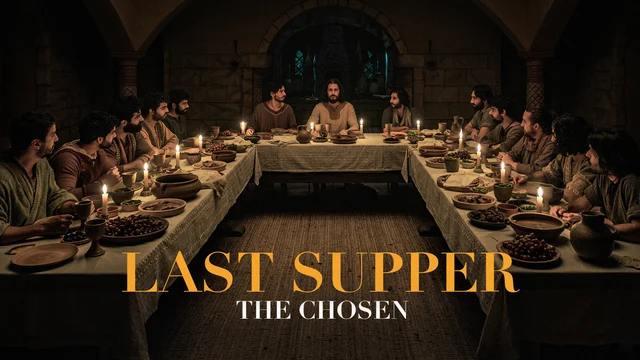
And we’re all going to stand during this video. And we’re going to allow the Chosens the scene of the Last Supper. We’re going to do communion with them. It’s kind of. Kind of cool.
Something different. I hope it works out. Well, you know, we haven’t done it yet, so I’m hoping it works out. But in the Seder, in the Passover Seder, there’s 14 steps. There’s 14 steps.
So they didn’t just come together and have a meal and break bread. And drink wine. And that was it, you know. No, no. If you even watch the Chosen, they’ve done a good job of articulating how it was, how they got together.
They shared stories and they sang songs. And it was a system. You go through it. You go through it and you celebrate the Passover. You celebrate their redemption from Israel.
And then they would drink of the first cup. They’d start the meal with the first cup, and then they would eat bread. They’d share those Passover stories. They read scripture. And then they’d have the second cup.
They’d have a second cup. And after the second cup, they would actually eat the dinner, the supper, the Passover supper. So they would have the lamb, the Passover lamb. And then there was a third cup. When we get to the story of Jesus in Matthew, they are at the third cup.
They’ve already had two cups, but they’re at the third cup. And it says this, if you’re following along. Matthew 26:26 29. It says, while they were eating, Jesus took bread. And when he had given thanks, he broke it.
And he gave it to his disciples, saying, take and eat, this is my body. Then he took a cup, and this is where the third cup happened. So he takes the cup and he uses it differently. Instead of remembering and going back. There’s another purpose, there’s another fulfillment getting ready to take place.
And he changes it up. And he says, in this. And when he had given thanks, he said, drink from it, all of you. And I tell you this. And get this part in verse 29.
Skip over verse 29. He says, and I tell you, I will not drink from this fruit of the vine from now on until the day when I drink it new with you in the Father’s kingdom. He never took the first cup. The fourth never partook of the fourth cup. The third cup.
He ended with the third cup. What does that mean for you and me? That one day when we’re in heaven, it tells us that Jesus is a groom and we’re the bride. And there’s going to be a feast in heaven, a marriage feast in heaven. And when we enter into heaven, we enter into this party, in this room, and everybody’s there that we’ve ever loved.
The church is there, you and me, and everyone is there. And Jesus is there. And Jesus says, welcome, here’s my cup, the fourth cup. That I have fulfilled everything. And you’re here today in heaven to spend the rest of your life with me.
Or death. Life, eternity with me in heaven. All of Heaven. The ultimate fulfillment is to spend eternity with him. Eternity with him.
Father. We thank you, God, for these cups, Lord, these promises. Lord, you’ve saved us, you freed us. You give us purpose. And ultimately all these things are fulfilled in you, Lord, which gives us true meaning to this life.
Lord, we thank you for your promises. We thank you that every one of them are available to us. And every one of them are. Yes and amen. And you, God, if there’s someone here today that doesn’t know you as Jesus, they’ve never drank of the first cup.
May they experience you today with all heads bowed and eyes closed. I just asked this, have you drank of the first cup? Have you actually drank of that cup where you are rescued? You were brought out because he can’t do any of these other things until that happens first. You need to be brought out of Egypt.
Is that you today? Would you believe in Jesus, that throughout your traditions, throughout what you thought church was, and it’s just you and God right now, you and God, you in heaven, would you just confess to him? Jesus, I’m a sinner. The day I want to drink of that first cup. I give my life to you today, Lord.
Would you come into my life? Would you be my friend? Would you be my savior? Would you be my king? I want a relationship with you, Jesus.
So today I confess that I am far from you, but I want to be close to you. Will you make me close to you? Through the cross, through the blood of Jesus, through the Lamb, I receive you as my savior. I receive you as my king. Amen.
Amen. Can y’ all give God a hand clap of praise? Hallelujah. Hallelujah.